Sacred art has always been central to Dominican life. I’ve been fascinated by Fra Angelico’s sacred art for most of my life, spending much time at San Marco in Florence, exploring and being inspired by his art. In this article, however, I want to explore the enduring influence of an almost unknown Welsh modernist artist.It’s a story of three archbishops, a cathedral, a minster, and a chapel, each influenced in different ways by the Welsh artist Ceri Richards.
Richards, a working-class, nonconformist, Welsh-speaking artist, created sacred art in Liverpool, Oxford, and Swansea. His creative use of space and light at Liverpool Cathedral, his modernist Supper at Emmaus at Oxford University, and his provocative Deposition captured the post-war mood of trauma and hope, destruction and beauty. His sacred art, grounded in a vivid geographical imagination, resonated with place and space, disrupting ways of relating to light and emptiness. Richards’s oil paintings capture Christ’s intense, questioning presence. However, Richards’s Christ in the Supper at Emmaus is modern, exaggerated, and cartoon-like. The realism of Christ’s oversized hands and feet, together with the serenity of His face, highlight surrender to God’s purpose. Richards’s Mannerist feet and fingers disrupt the serenity of the early Renaissance and present a Christ still active in the world. His work at Liverpool Cathedral aligned with the church’s vision, yet archival evidence from Liverpool shows bitterness towards modernist sacred art.
Richards, an outsider in England and not entirely accepted in Wales, was regarded with suspicion as a London-based artist, which led to his fading from public view. In a way, Richards was far too English for the Welsh and too Welsh for the English.
Liverpool Cathedral
Richards’s artwork at Liverpool Cathedral was set against a backdrop of a changed liturgical and architectural setting in the 1960s, with a shift towards lay participation, the use of the vernacular, and a move away from traditional forms of worship. Internal architecture was repurposed to reflect these changes. Vatican II suggested that sacred art in a liturgical space make transcendent references as ‘signs and symbols of things supernatural.’ Liturgical celebration was the primary purpose of the church interior. However, over sixty years after his innovative architectural repurposing, responses from art history to Richards’s work have been limited. His biographer, Mel Gooding, devotes only two pages to sacred art and omits Richards’s work at Liverpool. Richards’s art, shaped by his daily Bible reading as a child at Ebenezer Chapel in Dunvant, reflects his understanding of Gospel narratives.
His sacred art features deep religious imagery, bold colours and light, and lyrical exuberance. Richards agreed with Thomas Merton that churches should not be relics of the past. Some saw abstract art in sacred spaces as weakening the Church’s spiritual and historic relationship, but Richards’s art enhanced spirituality, embracing post-war calls for change and modernisation, as well as contemporary ideas about making religion rooted in communal participation.
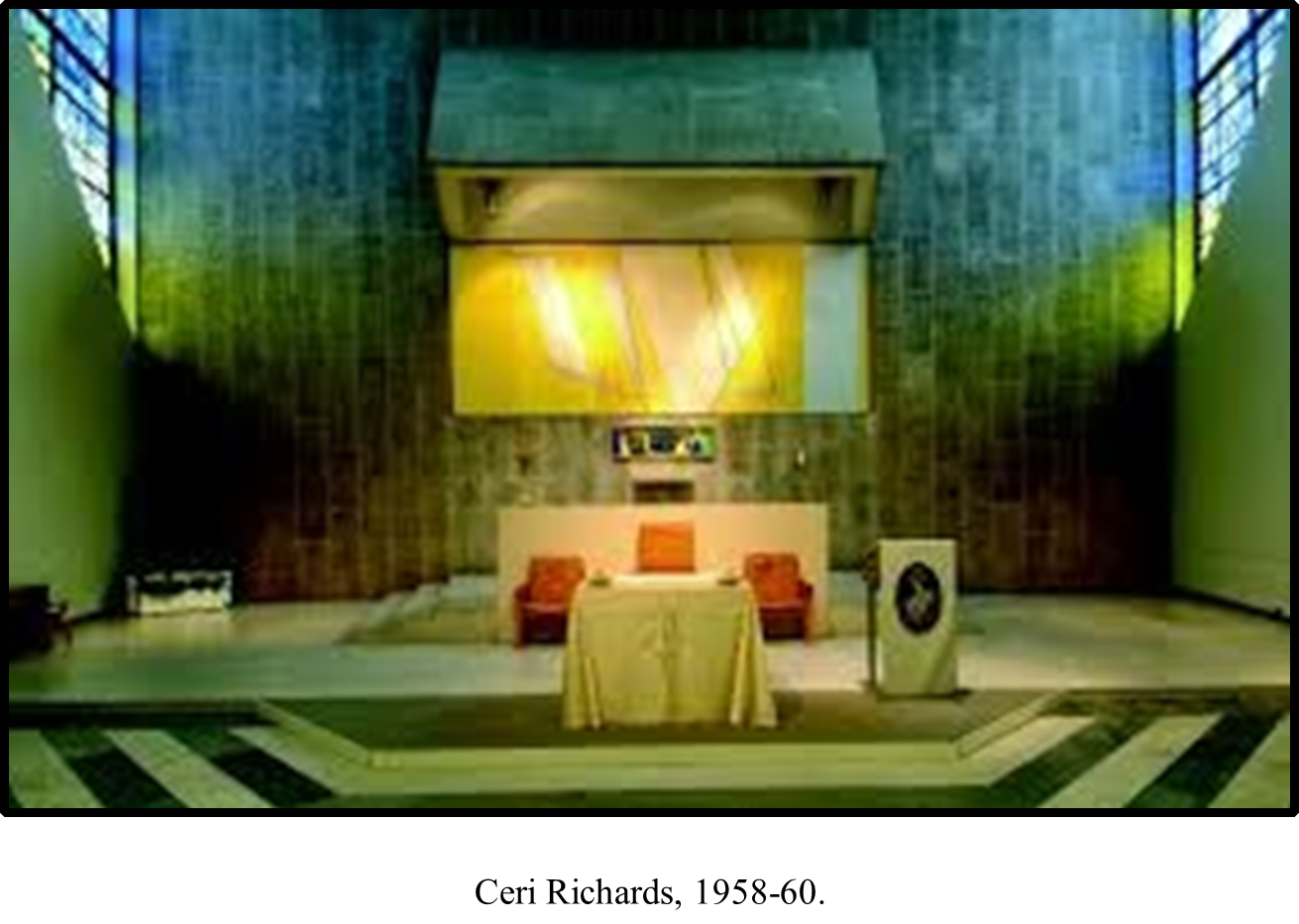
Welsh Nonconformity focused on building places of worship and the granular detail of what that meant. Richards faced opposition and practical issues, like the massive reredos, complex windows, tabernacle, and altars. Henry Moore believed Richards understood three-dimensional form and could convey it on a flat surface, giving physical expression to Vatican II’s vision by repurposing the altar to be ‘among the people’. Archbishop Beck recommended Richards for the commission, recognising the Church’s need to connect with the modern world. This was a leap of faith. In the Cathedral’s opening programme, Beck observed that it was a building expressed in contemporary design, using twentieth-century structural techniques, positioning Liverpool as the physical manifestation of Vatican II’s mission. The Eucharist was to be celebrated as a community, not as a private act of a celebrant. The interior architecture of Liverpool promoted liturgical renewal and pastoral outreach. Richards knew how to make religious spaces inclusive, was well-versed in scripture, and understood that the creation of an organic religious community depended on the design and use of space. White argues that Vatican II transformed the ‘house of God’ into the ‘house of God’s people.’ Richards was integral to this change, democratising sacred spaces through his use of space, light, and colour. His abstract designs, featuring symbolism on the altar front panels and tabernacle doors, used rich yellows, whites, and blue glass. Beck approved the designs, believing abstract art would give visitors peace, tranquillity, and a sense of God’s presence. The Eucharistic chapel has been repurposed over the years, revealing uncertainty in its reception. Originally meant for reflection and adoration in the presence of the Blessed Sacrament, the chapel’s distinctive, calming colours and natural light created an ever-changing quiet awe. It was a space for contemplation, reflection, and adoration.
In August 2024, the then-Archbishop of Liverpool, Malcolm McMahon, a Dominican, shared his thoughts on Richards’s chapel and his use of space and light. He argued that Richards’s work has an unexpected impact, arguing that the sparse, white reredos draws one into a void that symbolises God’s vastness. He explained that this unknown God becomes visible in the Eucharist when one’s eyes fall on the tabernacle. This effect is clear in the evening darkness, with the reredos lit by artificial light. However, in bright sunlight, the chapel windows in blue and yellow direct one’s gaze outwards from the tabernacle doors to the world. McMahon’s observations about the colours, especially the white, blue, and Richards’s characteristic yellow in Supper at Emmaus, and the impact of sunlight, the contrast with artificial light, and the sense of a void, present a sympathetic view. He noted that Richards presents the Eucharist as divine food that feeds our souls, requiring us to share unblessed bread with our neighbours outside the church, showing how an Archbishop, imbued with Dominican tradition, recognises Richards’s commitment to presenting the Church as open to the world, eager to incorporate all that is good in human activity and experience into worship. Richards adapted to the space’s concrete and vastness, using his signature colours and creating a sacred space for contemplation. However, his work received muted critical feedback, as he was caught in a widening gap between subjective spirituality and the traditional religious understanding of revelation in the JudaeoChristian tradition.
Pope Paul VI met with artists in the Sistine Chapel in 1964, but Richards was absent, and no record exists of his hearing the message. However, the timing and dates suggest Richards was aware of the Pope’s words, as they resonated with his experiences in Liverpool.
‘We need you; our ministry needs your collaboration. We preach and make accessible the world of the spirit, invisible, ineffable, and God. You are masters in this, transmitting the invisible world in accessible formulas.’
Pope Paul VI
Richards and Archbishop Malcolm served at Liverpool Cathedral for over fifty years. Richards was faithful to Vatican II’s mission, understanding its broad ideas, even if not all its theological complexity. In his 1986 papal address to Christian artists in Rome, John Paul II said that both art and faith celebrate human greatness and our thirst for the infinite. He acknowledged that Christian artists evoke the mystery of the ineffable through the beauty of sensible forms. He believed that Christian artists have a vocation in the Church and the world, as their symbolic language reveals the reality beyond things. In his Letter to Artists, Pope John Paul II argued that art should make the spiritual world more accessible and appealing, without losing its transcendent value. He saw beauty as a key to understanding the mystery and a call to transcendence, consistently affirming the right and usefulness of venerating sacred images.
In 2009, Pope Benedict XVI invited artists to the Sistine Chapel, following in the footsteps of Pope Paul VI, and discussed the concept of beauty. Pope Benedict’s words capture the essence of Richards as an artist in his pursuit of beauty, his desire to know, and his looking beyond, thereby unlocking the yearning of the human heart.
Supper at Emmaus
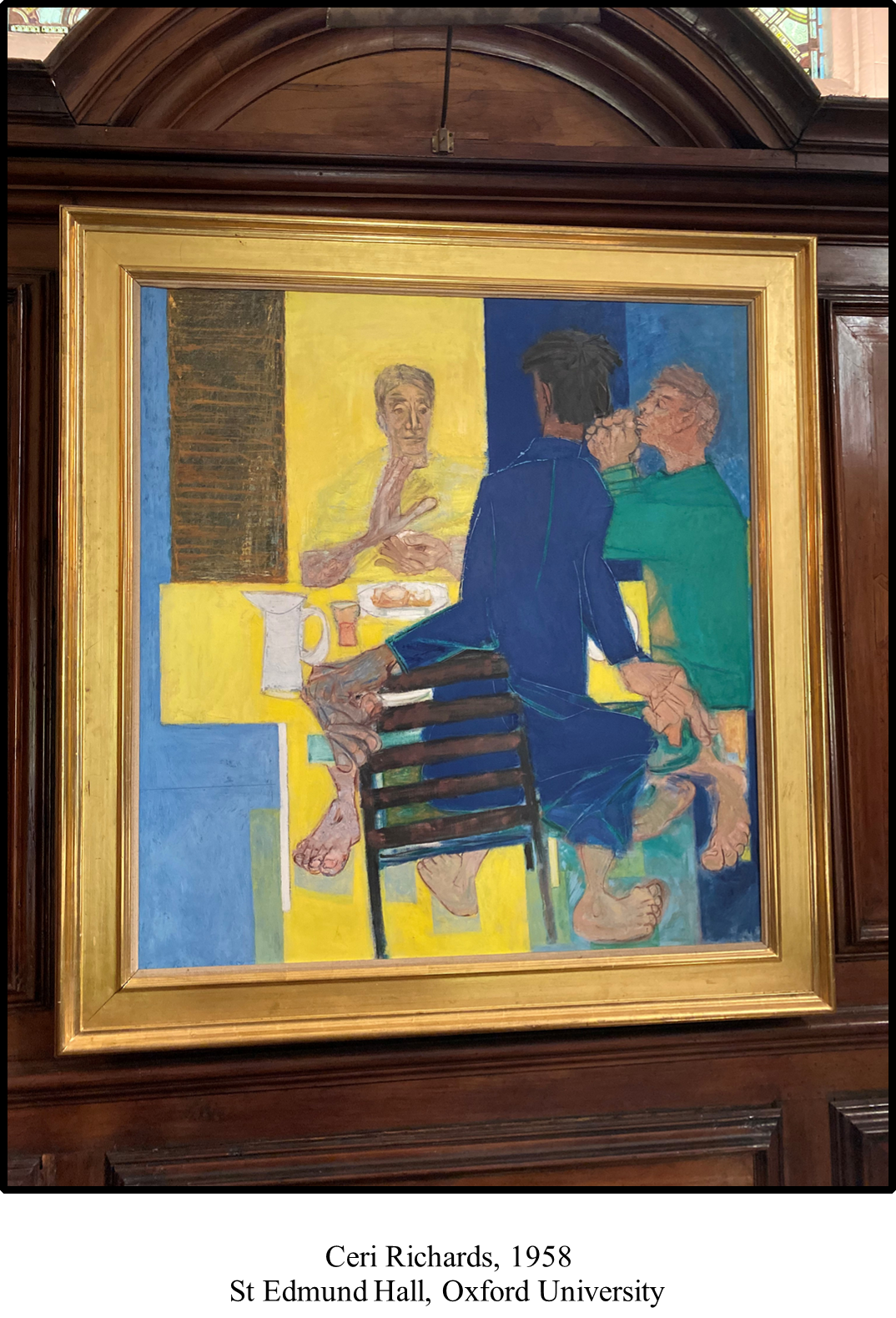
St Edmund Hall, Oxford, stands in stark contrast to Liverpool Cathedral, Rome, and the papacy. Founded in 1317, it embodies Anglican conservatism. The beautifully ordered archives reveal a community at ease with its role in promoting modernist sacred art. In 1958, St Edmund Magazine claimed that the purchase of Richards’s oil painting The Supper at Emmaus as an altarpiece for the Chapel sparked widespread excitement and enhanced the Hall’s reputation. This claim is extraordinary given the Hall’s English establishment roots.
Welcoming modernist abstract art from a Welsh-speaking nonconformist artist whose father worked in a South Wales factory is unusual. Richards’s reception into English and Anglican culture challenged preconceptions about Oxford colleges’ interactions with outsiders. The circumstances of the painting’s commissioning reveal much about St Edmund Hall’s perception of Richards as an artist.
Richards’s intelligent and lively image, combined with his rigorous intellectual approach, earned him praise and St Edmund Hall was seen as a centre of artistic pilgrimage. Oxford art connoisseurs recognised him as one of the ‘most distinguished younger artists’. Some even compared Richards to Rembrandt, Rubens, Titian, Veronese and Caravaggio, saying his modern idiom stood in the grand tradition of the masters. Wallis of The Observer and Russell of The Sunday Times praised his work, with Russell noting that it honoured both the artist and the commissioner. These views from St. Edmund Hall in the late 1950s, in the post-war years, signalled a change in attitude. However, the Hall’s archives show the reception was genuine. Older Common Room members were receptive to innovative interpretations of biblical narratives, eager to commit to abstract art and embrace modernism. They reassured doubters that Richards’s contemporary art was rooted in scripture and sophisticated technical ability. The critical reaction to Richards’s image muted opposition. The positive reception was encouraging and optimistic. The Sunday Times’s praise of Richards’s work for honouring both the artist and his commission pleased both St. Edmund Hall and Richards.
Comparisons to Rembrandt, Rubens, and Titian must have delighted Richards. While Caravaggio and Richards were different artists with distinct styles, even suggesting a comparison between their art is to greet Richards’s work with critical acclaim.
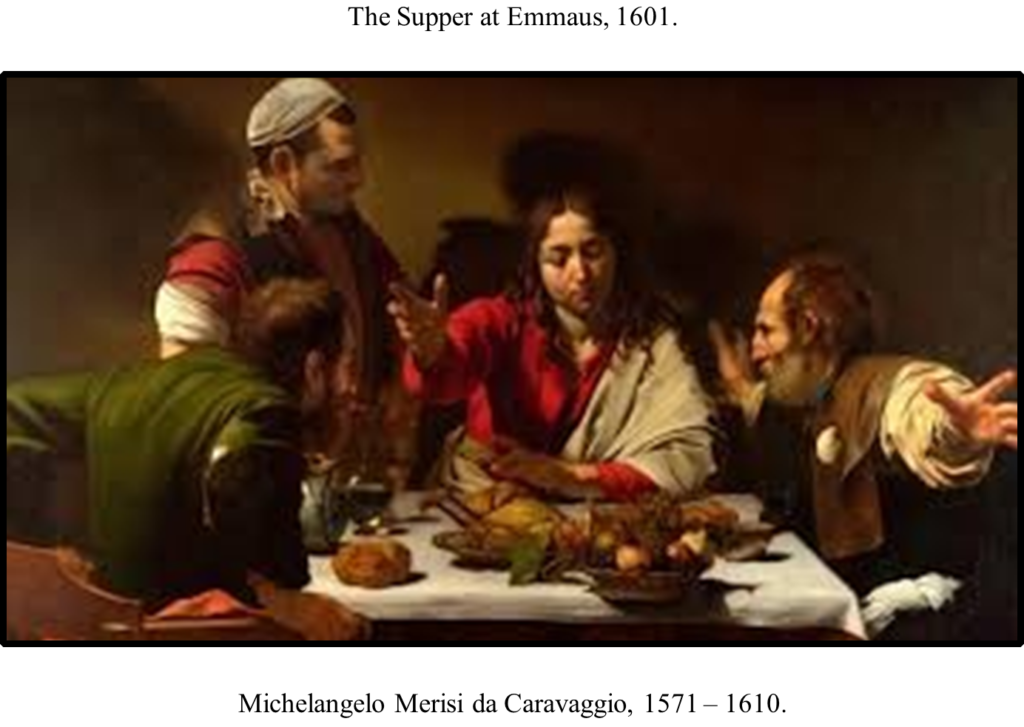
Caravaggio’s Supper at Emmaus, set against the backdrop of Counter-Reformation fervour, contrasts with Richards’s post-war image. Caravaggio’s narrative ambiguity reveals the story’s complexities. Richards reimagines the Supper in a post-war 1950s context, creating a dialogue between the past and the present. Caravaggio’s vast painting, with its tactile space, evokes proximity, immediacy, and atmosphere. Schama describes it as ‘the most powerfully physical Christian art ever painted.’ Caravaggio’s dark, shallow space reveals a scene of revelation and theatre, achieved through dramatic chiaroscuro. Schama calls him an ‘unmistakable genius.’ Caravaggio’s beardless, youthful Christ contrasts with Richards’s older, ordinary Jesus. Both break with conventions, without drum rolls, flowing beards, or choirs of angels. Caravaggio’s image is rough and elemental, while Richards’s is quieter and contemporary.
Light holds great significance for Richards, especially in his work at St Edmund and Liverpool. At Emmaus, Christ appears and dissolves into the yellow, showing His ability to change forms. Richards’s Supper at Emmaus focuses on the verse: ‘He took bread, blessed it, broke it, and gave it to them; and their eyes were opened, and they knew him; and he vanished out of their sight.’ The image is a visual homily with three figures: an absent Innkeeper and two fearful disciples. The intense colours of blue, yellow, and green, along with the oversized disciple’s feet, depict arduous journeys. The shared meal, the Eucharist, provides nourishment. Christ is seated against a yellow cross of light, outlining Him as He melts into it. Light is crucial, expressing tonal unity through the organisation of colours by their lightness and darkness. It falls behind Christ, forming the background from which he emerges. It is the light of eternity, in which he is momentarily figured in human form as the disciples react to the revelation. One rises awkwardly, pushing the chair aside; the other, seated at the side, is disturbed but uncomprehending, his clasped hands pressed to his mouth, ponderously readjusting his mind in confusion. Like Caravaggio, Richards makes the Emmaus story a ‘parable about those who see and those who do not’. His uncluttered, rich-in-colour and light image dominates the formal, austere chapel at St Edmunds Hall, unlike Caravaggio’s iconography. Richards’s image in the chapel changes with the light, challenging and responding to the viewer’s gaze. It narrates its spiritual story with precision and coherence, inviting the viewer into a dramatic and tense moment. Like Caravaggio’s piece, it demands attention and focus. Richards’s Supper at Emmaus deserves more acclaim, but critical analysis has been muted. The Hall deserves credit for commissioning the painting and nurturing its presence for over sixty years. Richards’s innovative modernist interpretation of a familiar biblical narrative deserves more scholarly attention. Drawing on his diverse life experiences, he offers a fresh and challenging artistic realisation of a well-known scriptural narrative. His characters feel modern and alive, yet caricature-like in their realism, reflecting his artistic exposure and life experience.
The Deposition
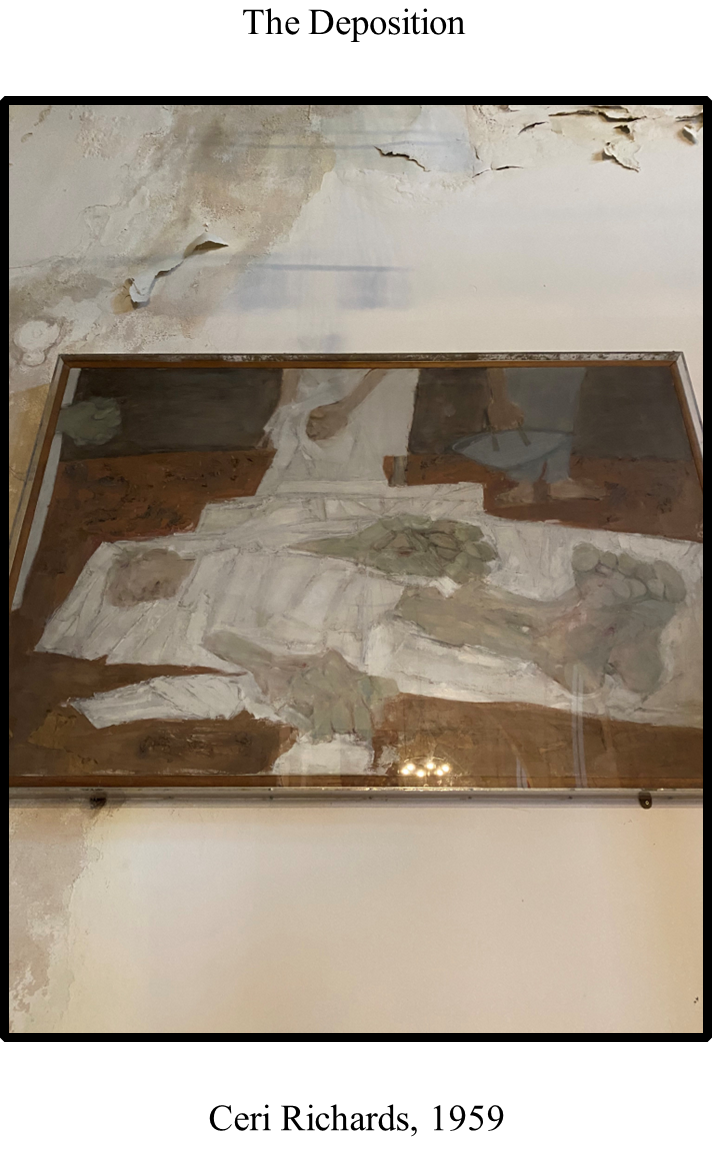
Richards’s The Deposition at St Mary’s shows Jesus’s brutalised body on a white sheet, surrounded by execution debris. Feet play a significant role in his images, prompting questions about what is included and what is omitted. Where are Mary and John? Why is the image devoid of emotional resonance? Why is it so sombre, without consolation or hope? Thirteenth-century St Mary’s was familiar with war and was bombed to ruins in 1941. The Deposition, submitted to the Tate Gallery in 1958, depicts Christ’s distorted limbs, conveying the agony of execution. Tom Holland argues that crucifixion aims to humiliate and dehumanise the victim, demonstrating Roman might. The bystanders’ indifference highlights the event’s casual, brutalising nature. The only face depicted is Christ’s, with everyone else anonymous, suggesting collective responsibility. Both The Deposition and Supper at Emmaus depict encounters with God. The carpenter leaves the dead Christ under the Cross, and the disciple encounters the Risen Christ at Emmaus. Both artworks show Christ’s swollen, exaggerated limbs.
Rowan Williams, former Archbishop of Canterbury, argues that The Deposition is an uncomfortably stark work about the disposal of the unwanted. He believes that clearing the space around the Cross frees the image from preconceived interpretations and reactions, anchoring it in a disturbing material particularity. This ‘clearing of space’ is a feature of Richards’s art at Liverpool, Oxford, and Swansea.
Williams emphasises Richards’s Deposition as a significant artwork, supported by his theological expertise and scholarly reputation. The artwork’s precarious position in St Mary’s church in Swansea symbolises Christ’s enduring presence and Richards’s precarious artistic status. Richards’s closely observed, reflective artwork, rooted in colour and form, has influenced how art responds to sacred space and Gospel narratives. At Liverpool, St Edmund, and St Mary’s, the churches respond to Richards’s images as the day progresses and light sources change. St Edmund’s Chapel, mostly wood with high stained-glass windows; Liverpool’s Chapel, with its concrete and shifting light; and St Mary’s, with its neo-Baroque grandeur, are framed by Richards’s images, which emerged from a post-war desire for reconstruction and a shift towards liberal interpretations of the Gospel message in liturgical practices.
Richards’s interior architecture of Catholic spaces in Liverpool uses space and light to convey distinct ideas about sacred space. St. Teilo’s, St. Francis, and St. Paul’s in Cardiff are post-Vatican II churches influenced by Richards’s use of natural light and the colours white, blue, and yellow. Supper at Emmaus marks a radical shift within conservative Anglicanism, while Deposition at Swansea invites modernity to contemplate Gospel narratives in a post-war world. Language, ritual, space, place, and architecture all contribute to the construction of sacred spaces.
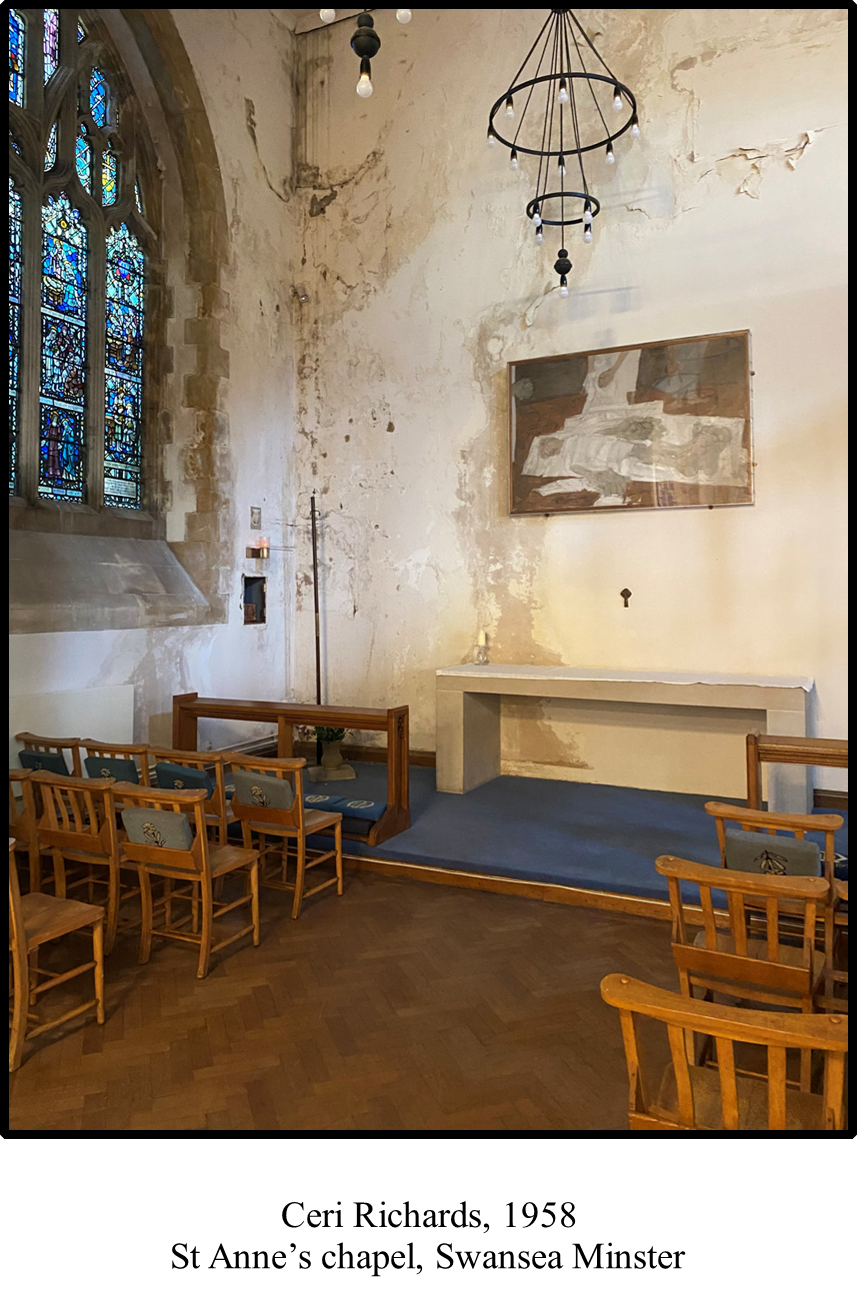
Swansea Minster has a vibrant musical culture and houses Richards’s dramatic modern art. St Anne’s chapel, with its high ceiling and damp, decaying smell, features peeling paint, grout, and mould. A makeshift tent on the side altar may serve as a bed for the homeless. The gloomy, musty space houses Richards’s The Deposition. Unlike Catholic sacred art associated with the Deposition of Christ, this stark image unsettles and challenges viewers, showing Christ’s brutalisation without the solace of a Pieta or Fra Angelico. Its modernity and cartoon-like quality reflect alienation.
The absence of solace highlights the chapel’s special, sacred space, unadorned and discarded. Space and place create their atmosphere, drawing on the church’s experiences of rebuilding, migration, bombing, industrialisation, war, and change. Monumental events deeply touched this space, shaping its sacredness. Richards saw it as an ideal setting for his Deposition, exemplifying Keith Moxey’s idea that art is an agent in its reception. Richards’s Deposition challenges traditional interpretations of Christ’s deposition from the Cross.
The Swansea Minster, now undergoing a transformation, prominently displays the Deposition, accompanied by audio presentations and striking signage. On St David’s Day, I gave a presentation at the Minster on Richards’s sacred art, advocating its re-evaluation to appreciate its depth and provocative nature.
Richards’s sacred art deserves exploration and reflection, as it stands firmly within a Dominican tradition. The words of Archbishops Malcolm, Beck, and Rowan Williams will ensure that Richards’s sacred art attracts attention and consideration. Oxford, Swansea and Liverpool invite Lay Dominicans to reflect on Richards’s key role in post-war modernist sacred art within a tradition that places high value on the aesthetic and the spiritual.
Dr Christopher J. Crowley, April 2026.
Cardiff, Wales.