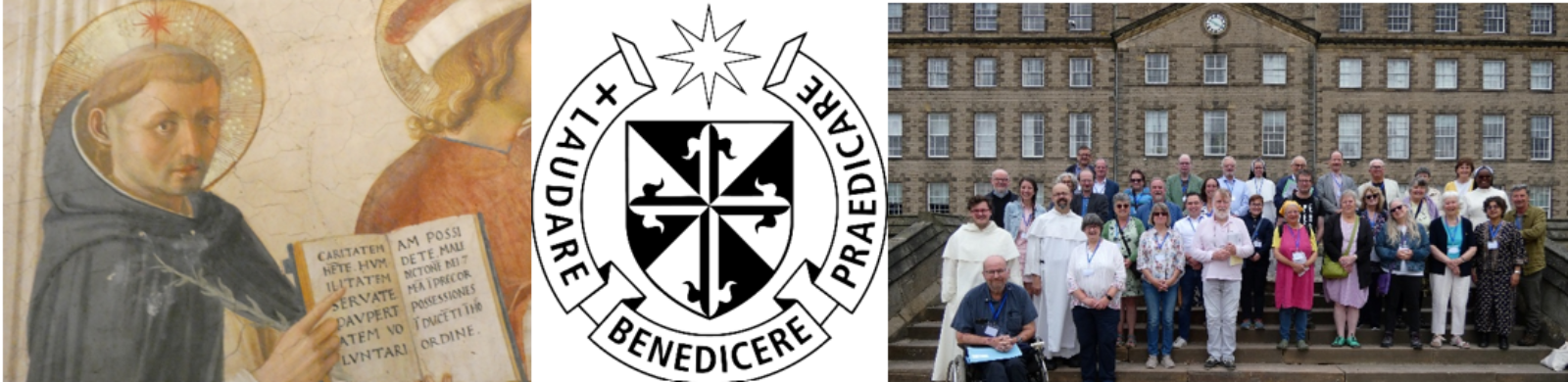
“Brother John, a Man Outstanding in the Spiritual Life and in Art”
from Pope St. John Paul II on the occasion of the Beatification of Fra Angelico 1982
His art is so familiar to us as Dominicans. Yet we sometimes forget that he was not a great artist who happened to be a Dominican friar, but a Dominican friar who happened to be a great artist. So who was fra Angelico?
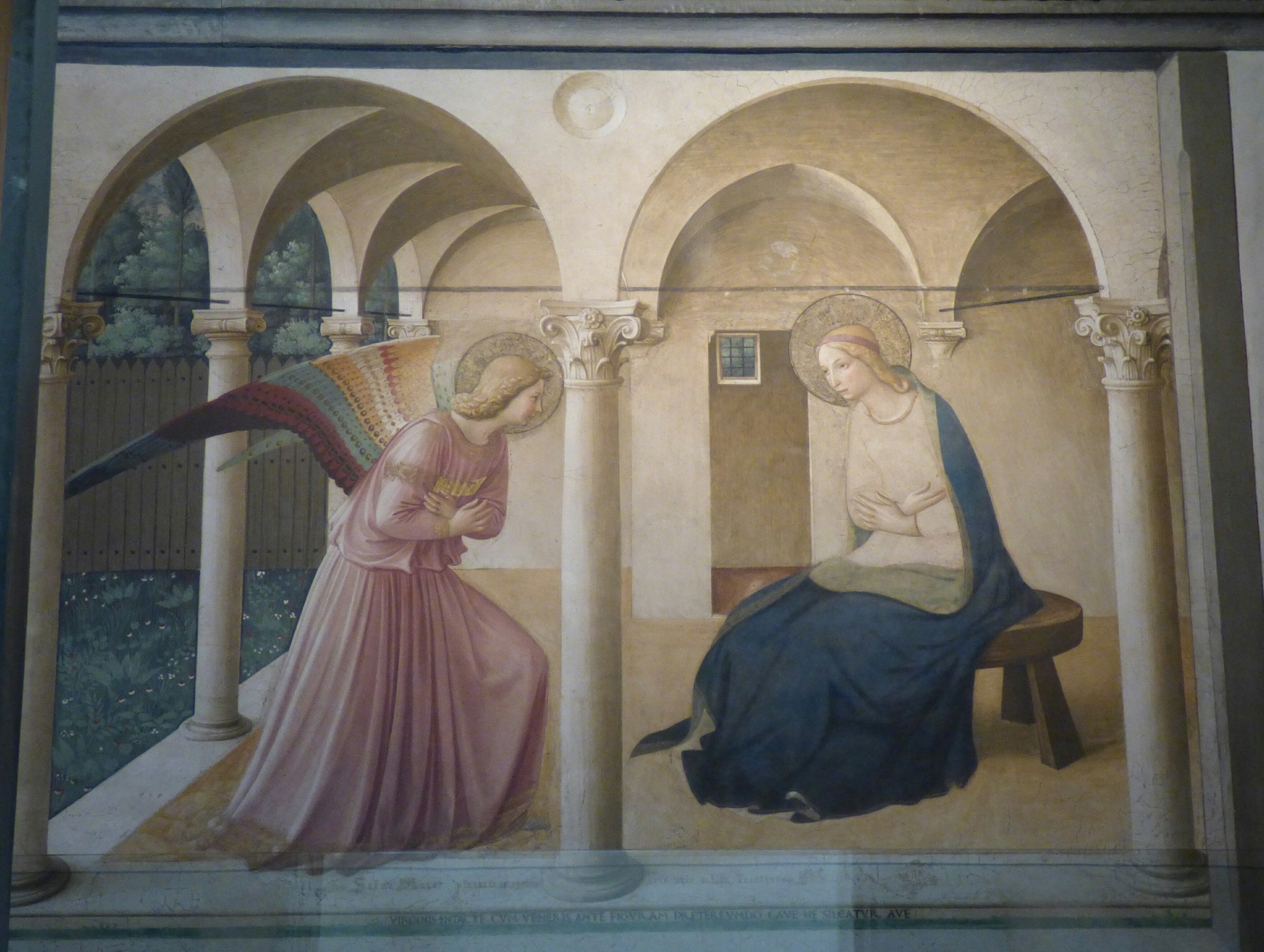
He was born in 1395 and his name was Guido di Pietro. He took the name Giovanni (John) as his name in religion, but is more usually known as fra Angelico.
He spent most of his life in and around Florence, which was a huge trading centre and extremely wealthy. By 1300 the population was 120,000. But the Black Death was devastating. The 1400 outbreak was when fra Angelico was a child, and by 1427, when he was active, there were 38,000 people in a city built for 120,000. Still a place of wealth but there were many empty spaces & derelict buildings – a city built for a population 3 times the size.
The Dominicans were a very strong presence in the city. S. Maria Novella was built, and Giotto’s cross was already there as well as the Spanish Chapel frescoes, but not Masaccio’s Trinity, and the church did not yet have its black and white front. This was the period when the popes were returning from Avignon, but there was still a lot of unrest in Rome and the Master of the order was resident in SMN from 1417, and Pope Martin V and his court arrived in 1419 and stayed 18 months. The presence of the papal court affected all Florence. There was significant investment, including, during the Pope’s stay, extra decoration inside the church of S. Maria Novella. A young artist, Guido di Pietro, from the Mugello, aged 23, was commissioned to carry out works.
We know very little about his early life. We don’t know his father’s occupation. We do know he had a brother and a sister. We don’t know when he came to Florence or where he did his apprenticeship. He is known to have done some work with the workshop of the Carmelite painter Lorenzo Monaco, but he was already an established painter and illuminator in his own right. None of the works he did for S. Maria Novella survive (inc. a fresco on the choir screen (with images of St. Dominic, (St.) Catherine of Siena and St. Peter Martyr).
It was probably this close contact with the order which led to him entering as a novice at Fiesole, where he took the name Fra Giovanni. He probably did 2 years’ novitiate in Cortona and was back at Fiesole in 1423, where he studied further before ordination. He wasn’t painting during those years but started again after ordination. He must have had a small workshop as there are so many items produced during the 1420s, including reliquaries, small paintings, manuscripts and altarpieces. And the predella of the S. Domenico altarpiece shows another hand, thought to be his brother Benedetto, who was a manuscript illuminator, and who entered the order a few years after Angelico and was ordained in 1429.
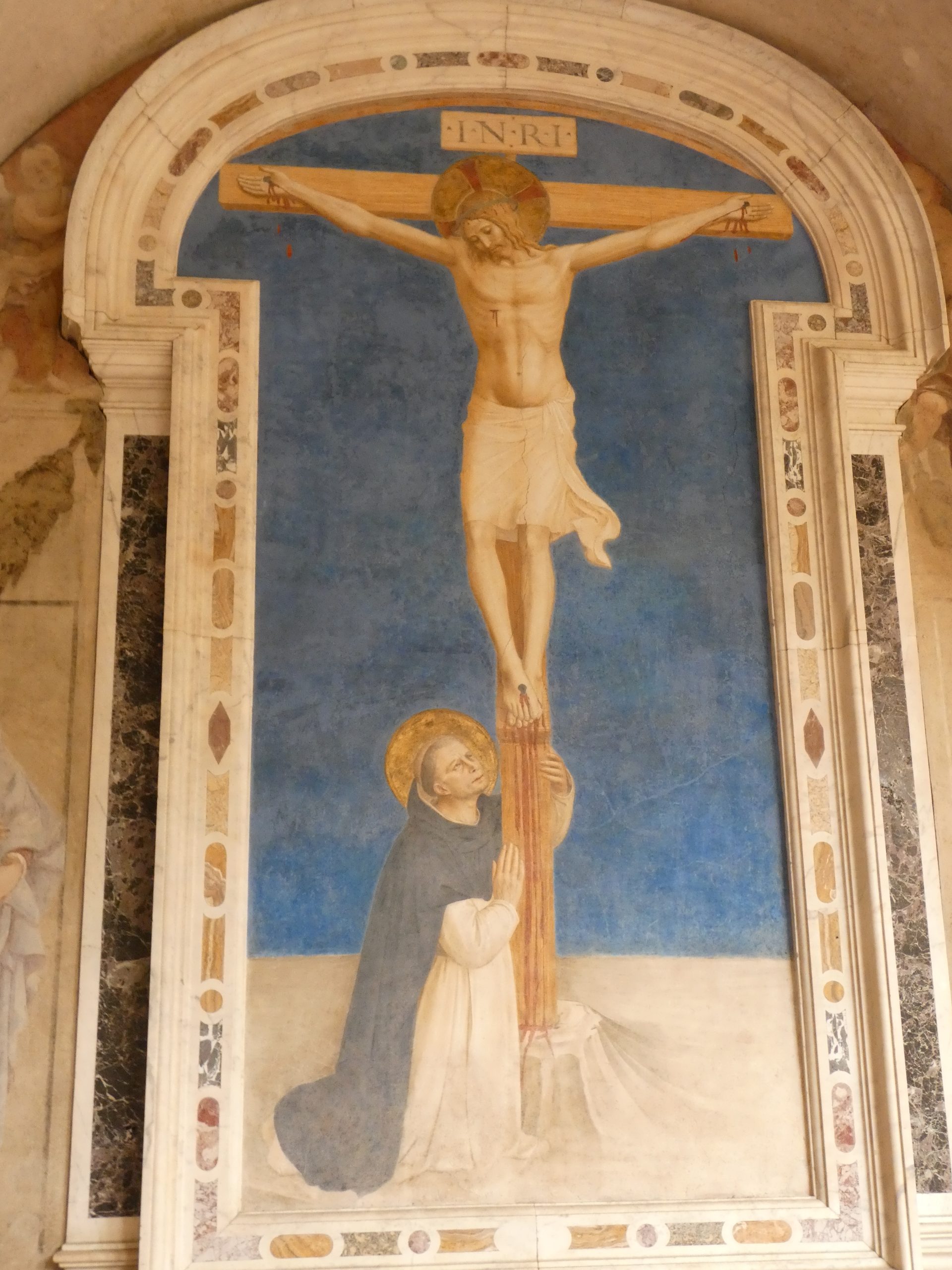
Fra Angelico was known for his personal devotion – he would kneel before starting to paint, weeping as he painted the crucifixion.
But fra Angelico was not just a painter. He had active roles in the order too and was Vicar at S. Domenico, Fiesole for 2 periods, covering several years. In 1438 Fra Angelico moved to the convent of S. Marco in Florence and began work on the frescoes.
By 1443 painting was almost completed but building work continuing on extensions to the convent including a library designed by Michelozzo. Fra Angelico served as bursar for 2 years during this time, so he must have been involved in major project management as well as his work as an artist.
The Pope returned to Rome in 1443, and started major building works. In 1445 he summoned Fra Angelico to Rome to work for him. Angelico had only just been appointed prior at Fiesole. He was replaced as prior by his brother Benedetto. He took up residence in the Dominican church of S. Maria sopra Minerva.
In 1450, Benedetto died, after serving as prior at Fiesole (at the same time as running a scriptorium) for 5 years. Fra Angelico was recalled to Fiesole to replace him. We know very little about the next 5 years. It seems that he produced few artworks. We do know, from examination of fra Angelico’s remains when his tomb was moved in the 20th century, that he suffered from crippling arthritis which may be why he was not working so extensively. He died in Rome 1455 and was buried at S. Maria sopra Minerva.
When he joined the Dominicans, he was known as fra Giovanni da Fiesole, as that was the convent he lived in, to distinguish him from other friars called Giovanni. Later in life he seems to have been known as fra Giovanni degli Angeli (of the Angels), perhaps initially a reference to the many angels in his paintings, but this had changed to fra Giovanni Angelico (the Angelic one) during his lifetime, because of his humble, prayerful way of life. Immediately after his death he was referred to within the order as Beato Angelico, and this became common usage. In fact, he was not beatified until 3 October 1982, by Pope John Paul II. His feast is on 18 February, and he is the patron of artists.
Margaret Doyle