
Veritas Spring Issue May 2026
The Lay Dominicans of England, Scotland and Wales
Recently, I have been thinking, how can I spread the Word of God in an increasingly divided and unpredictable world? As Pope Leo XIV says,
“Life shines brightly not because we are rich, beautiful or powerful. Instead, it shines when we discover within ourselves the truth that we are called by God, have a vocation, have a mission, that our lives serve something greater than ourselves.”
Then I came upon this short article, written by Fr F.W. Faber, Cong. Orat., and it struck a chord.
Kindness Kin to Godliness
“Now surely we cannot say that this subject of kindness is an unimportant one. It is in reality a great part of the spiritual life. It is found in all its regions, and in all of them with different functions, and in none of them playing an inferior part. It is also a peculiar participation in the spirit of Jesus, which is itself the life of all holiness. It reconciles worldly men to religious people; and rarely, however contemptible worldly men are in themselves, they do have souls to save, and it were much to be wished that devout persons would make their devotion a little less angular and aggressive to worldly people, provided they can do so without lowering practice or conceding principle. Devout people are, as a class, the least kind of all classes. This is a scandalous thing to say; but the scandal of the fact is far greater than the scandal of acknowledging it. Religious people are an unkindly lot. Poor human nature cannot do everything; and kindness is too often left uncultivated, because men do not sufficiently understand its value. Men may be charitable, yet not kind; merciful yet not kind; self-denying, yet not kind. If they would add a little common kindness to their uncommon graces, they would convert ten where they now only abate the prejudices of one. There is a sort of spiritual selfishness in devotion, which is rather to be regretted than condemned. I should not like to think it is unavoidable. Certainly its interfering with kindness is not unavoidable. It is only a little difficult, and calls for watchfulness. Kindness, as a grace, is certainly not sufficiently cultivated, while the self gravitate Ng, self contemplating, self inspecting parts of the spiritual life are cultivated to exclusively.
Rightly considered, kindness is the grand cause of God in the world. Where it is natural, it must forthwith be supernaturalised. Where it is not natural, it must be supernaturally planted. What is our life? It is a mission to go into every corner it can reach, and reconquer for God’s beatitude, his unhappy world back to Him. It is a devotion of ourselves to the bliss of the divine life by the beautiful apostolate of kindness.”
Is the War on Iran- a ‘just war’?
The American government has publicly justified the strikes on Iran as a “pre-emptive measure necessary to counter an “imminent threat”. This justification has been met with widespread scepticism from both the Catholic Church and international law experts, who argue that in opening hostilities during a time of negotiation and in the absence of an evidenced ‘immediate threat’, the war more accurately fits the definition of a preventive war. That is something quite different.
A pre-emptive war addresses a threat that is imminent and immediate. It is a response to an attack that is about to happen. A first strike can be necessary to catch the enemy before they launch any weapons. A pre-emptive war is often accepted as legitimate self-defence under international law on the condition that there is validated evidence to show a real and present danger.
A preventive war is a conflict initiated by a state to defeat a potential adversary before the adversary has acquired the capability to launch a future attack; or before a predicted shift in the balance of power can occur. Unlike a reactive war, the decision to launch a preventive strike is based on a long-term strategic calculation; a state chooses to fight now to prevent a potentially more dangerous or costly war later.
A pre-emptive strike responds to a ‘cocked pistol’. The US administration claims this is the case, but they have not shown the pistol. A preventive strike responds to the mere purchase of a pistol and ammunition by an adversary that you fear might eventually point it at you. It is this latter approach that more accurately describes the reality of the current situation. The US and Israel have seized an opportunity to degrade Iran’s nuclear and military capabilities now, rather than waiting for a future threat to fully emerge.
This approach to Iran by the USA and its allies is widely viewed as a violation of the United Nations Charter, which only permits the use of force in self-defence against an armed attack or with Security Council authorization. The threat justifying a preventive war is generally considered too speculative to meet the legal standard of imminence. The approach also faces strong opposition from Just War Theory. The criteria for a just war, such as that any military action must be a “last resort,” that it should have a probability of success and should be “proportional to the threat that is evident, are considered nearly impossible to satisfy when the threat is not immediate.
The judgement of the Catholic Church on the war on Iran is abundantly clear. It has gone about as far as it can in its public judgement without outright direct denunciation.
As evidence grows of ‘collateral damage’ from US air strikes on civilian non-combatant populations, Cardinal Pietro Parolin warns “if states were to be recognised as having a right to “preventive war,” according to their own criteria and without a supranational legal framework, the whole world would risk being set ablaze”.
The USA and its allies should stop bombing immediately and resume negotiations for a just peace as soon as possible.
Dominic Harrison
To Praise, To Bless, To Preach
On Saturday, 7th March, the Lay Fraternity of the Sacred Heart of Jesus, Crawley celebrated the final professions of Carole & Tony Martin and Joanna Goyaram. Mass was celebrated by Fr Terry Tastard, member of the Dominican Priestly Fraternity, at the beautiful chapel of the Missionary Sisters of the Sacred Heart Convent.
We hear much about ‘wars and rumours of wars’ in our troubled times, but the gatherings of our communities to praise and to bless, are a wonderful reminder that God has called each and every one of us by name, to preach His name and to live in friendship and communion with Him.
“Bless the Lord, you servants of the Lord;sing praise to him and highly exalt him forever.” Daniel 3:85
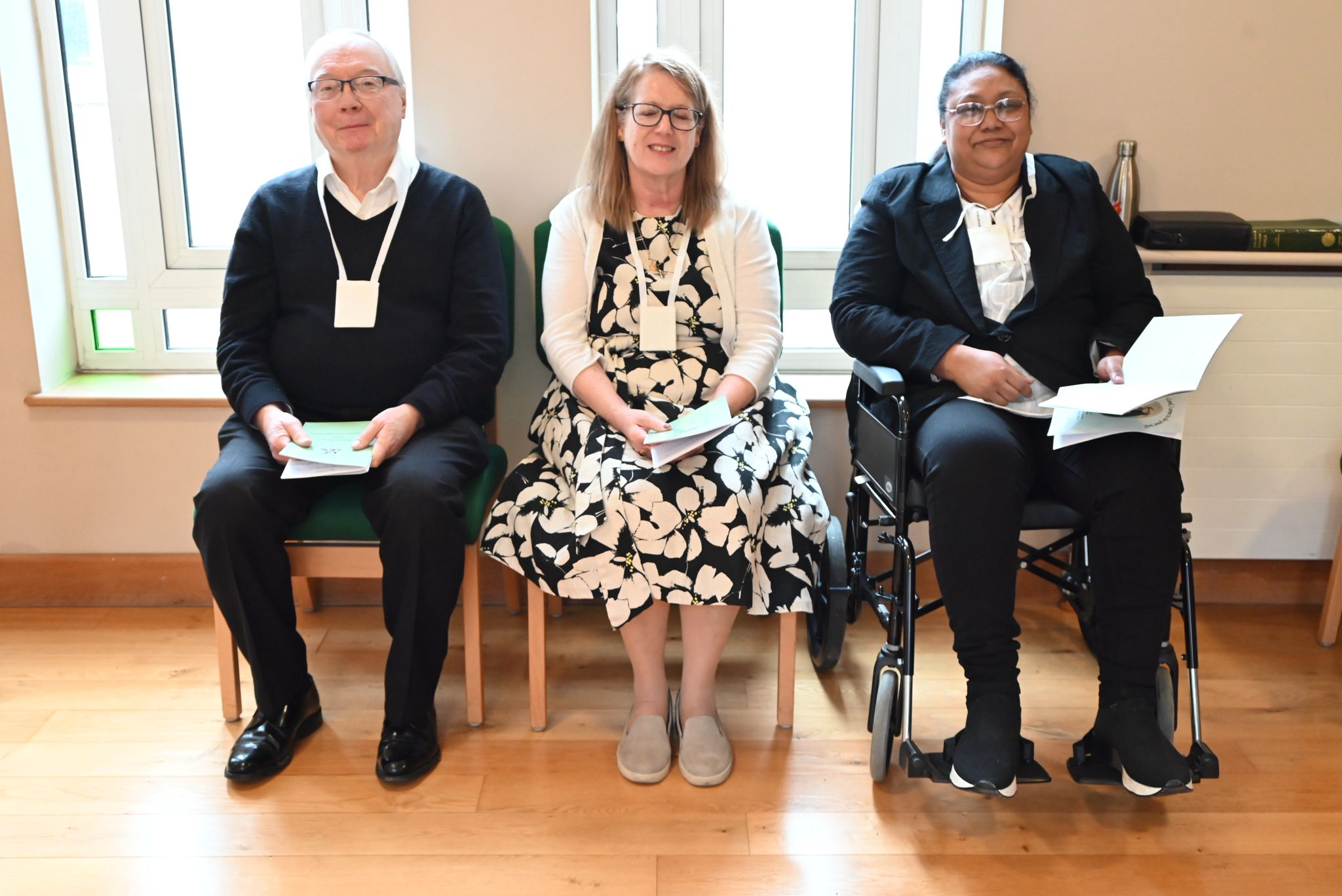
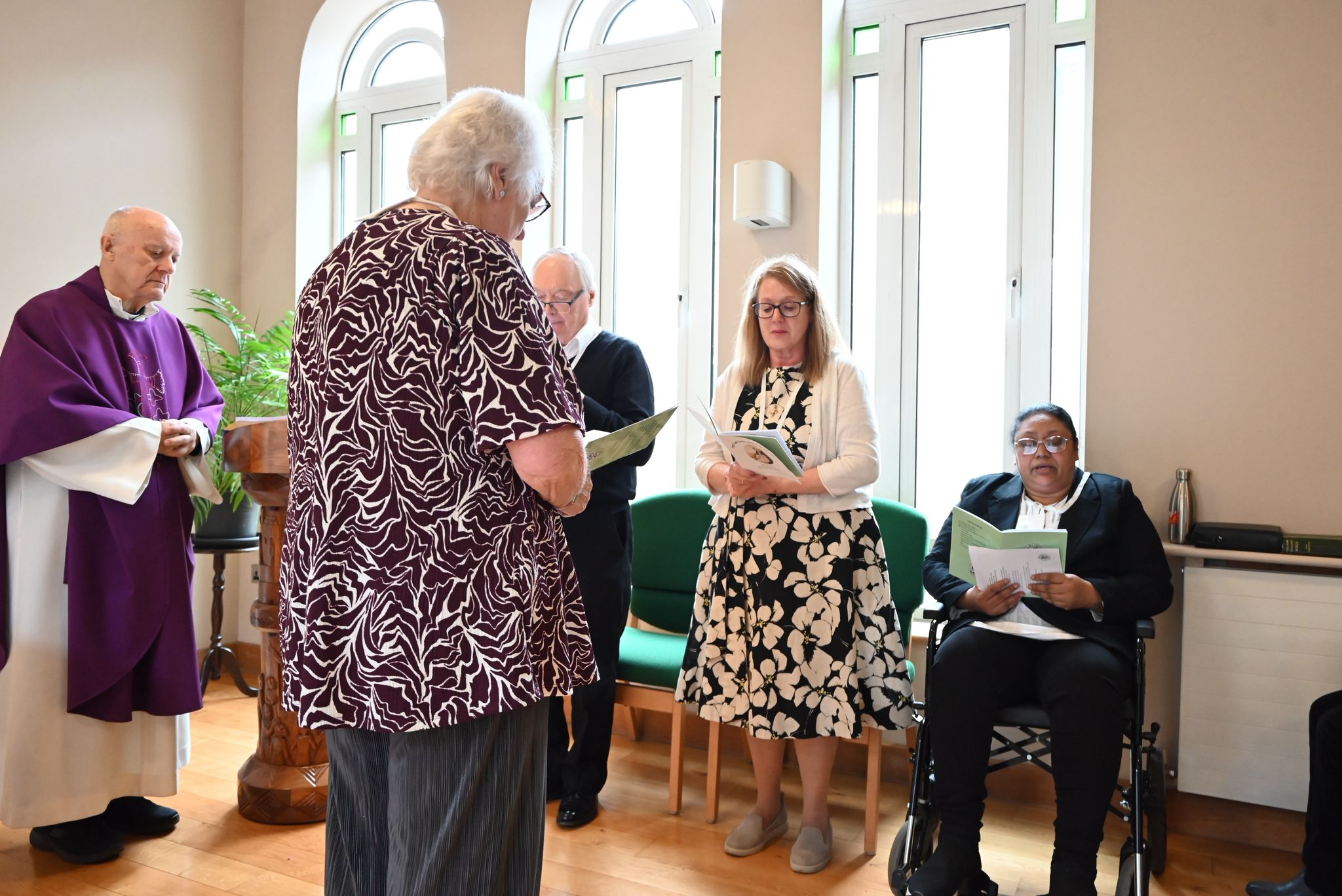
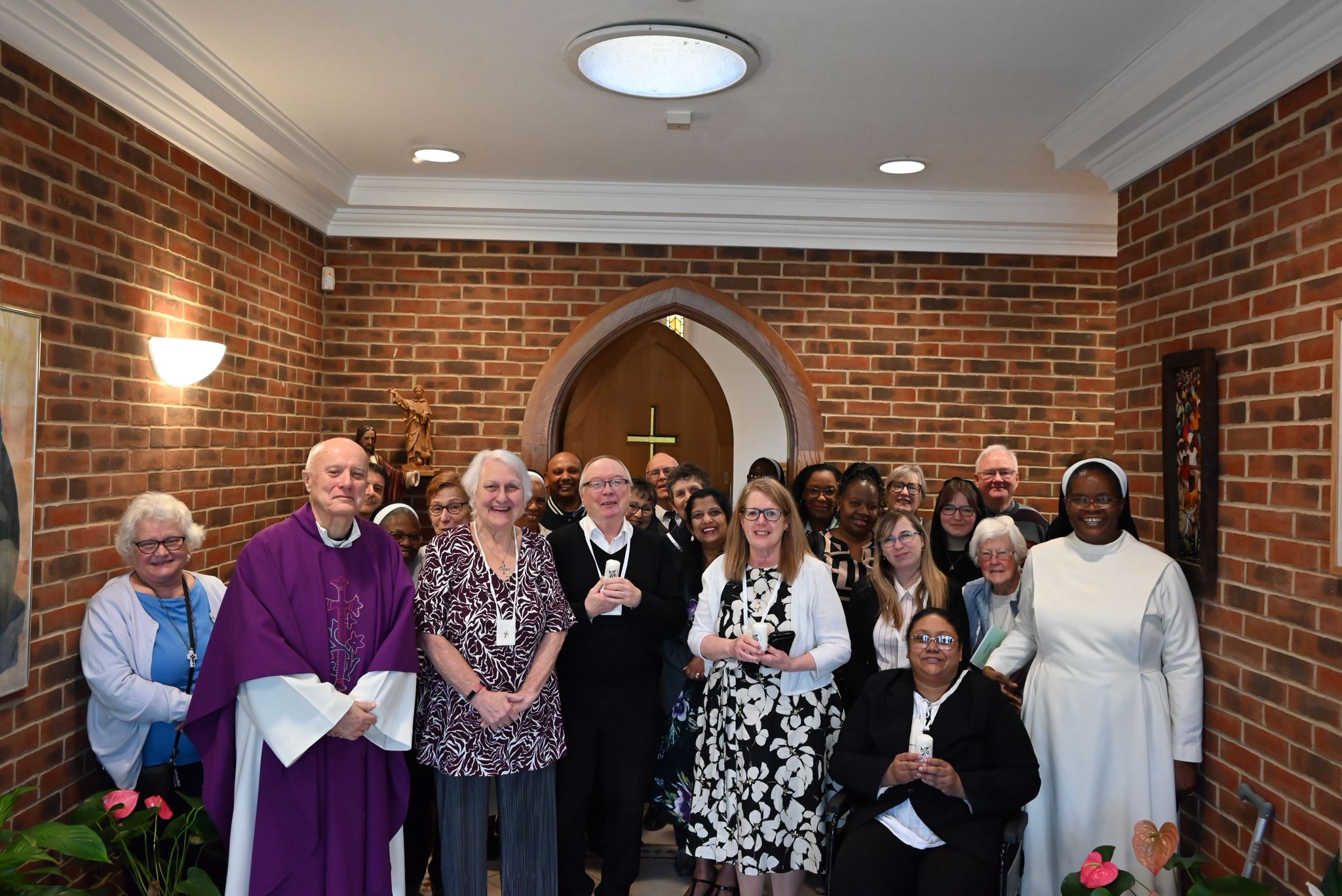
Fernanda Mee
Poetry corner
My Mum and Mary
I remember being next to my mother,
holding her hand, looking up into her face.
We were standing together in Mass
singing a hymn to Our Lady.
(For someone who disapproved of hymns to Mary,
coming from a protestant background,
it seemed strange that my Mum
was enjoying herself so much.)
My Mum was singing lustily,
Her cheeks were glowing,
her eyes were bright
and tears were flowing down her face.
This seemed strange to me.
How could she be happy
and sad at the same time?
Years later I came to realise
that in sharing the grief
of the death of her little girl
with someone who had also known
the pain of losing a child,
my mother was finding relief
for her tormented soul.
And in unburdening herself and sharing her sorrow
my mother was finding consolation with Mary.
Now when I sing these same hymns
I am that small child again.
Tears spring into my eyes as I remember
looking up at my mother, distressed yet glowing
being comforted by gentle Mary.
And I thank Mary for her love.
Elizabeth Davey
Ash Wednesday
Painstakingly
the cross
is inscribed on the brow.
The cross fades
as the day goes by but the dark smear remains.
A shout from the street:
“You’ve got dirt on your face.”
Yes, the dirt of life and death.
Yet the cross is there
beneath the smear
within the heart and mind
love’s power we find.
Peter Kilty
Good Friday
People seem embarrassed
at going into church on a Friday afternoon.
They enter shamefaced and silent.
The old continuing story is told.
A voice calls outside, a car revs up.
Supermarkets sell chocolate eggs
and an Anglo-Saxon goddess of spring
is recalled on wishes muttered in passing.
But the story will not go away.
It continues to stay in the commercial hustle.
A man is betrayed, our God dies .
This is real, not lies.
Peter Kilty
Emmaus
It is never far to Emmaus as we tell of disappointment and fear.
The road is walked every day.
As twilight turns to night
a stranger breaks into our sadness.
We walk the route,
too busy talking to look at the man.
He says nothing as we tell of disappointment and fear.
Inside a lamp is lit and a red glow warms the room.
The stranger breaks the bread and suddenly we see
whom we could have seen before.
He goes but remains
every time we break the Bread
Peter Kilty
The Edinburgh Fraternity remembers Fr Fergus Kerr OP (1931-2025), their religious assistant from the 1990s to 2012.
Biddy Gray: It was only at Fr Fergus’ funeral last December that I realised I must have seen him when he was a novice at Woodchester in 1956-7. I was a girl at St Rose’s school in Stroud, and we used to be taken for walks to Woodchester, which was quite a long way, so that we could have Mass when we got there. He would have been one of a large group of novices that year.
Fr Fergus became our Religious Assistant in the 1990s; before that, it was Fr Denis Geraghty. The thing I remember most clearly about that period is that Fergus fought to make sure we had space to meet. We met on the first Saturday of the month, and Fr Fergus would say Mass for just us at 3pm in the chapel in the Upper Room in St Albert’s, George Square. (Later on, it was decided that we should join the parish for the 12 o’clock Mass.) After that, we would go down to the student common room in 23 George Square to have the rest of our meeting, because there was nowhere else for us to meet. Some of the friars used to try and get rid of us, and tell us we shouldn’t be there. I remember Fr Tony Axe used to lock us out! But Fr Fergus would wait for us and let us back in, and tell us we were meant to be there, and that we should stand our ground.
John Rowan: I joined in 2012, just before Fr Lawrence Lew took over. I remember that Fr Fergus gave us a Lenten retreat one Saturday in the Common Room.
Both: There were about 6 or 7 of us there that time. We remember him talking all about his childhood in Banff, and the Dominicans in Scotland: how the house of St Albert the Great was started in 1931, the same year he was born. He talked about his pride in the history of Christianity in Scotland, how proud he was to be Scottish, and his respect for Presbyterianism and also the Scottish Episcopal Church. He talked about the Carmelites in Banff, and about Pluscarden- I think he might have thought of joining the community there, until he met the Dominicans.
Sara Parvis: Biddy and I, together with Margaret Malcolm from Dundee, represented the Edinburgh Lay Dominicans at Fergus’ graveside, joining in the Dominican Salve when he was lowered into the ground at Mount Vernon Cemetery. The weather was breathtakingly beautiful: clear skies and rosy low December sun, which shone on the funeral party as into one of those stone age Celtic chamber tombs which the sun only illuminates at the winter solstice.
Fr Fergus Gordon Kerr OP, may you rest in peace.
News from the Edinburgh Fraternity
Easter greetings from the Edinburgh fraternity! Here is some of our news.
Four of our novices made temporary profession in the autumn: Alison Deighan, Emma and John-James Colvin, and Margaret Malcolm. We also welcomed a new Religious Assistant on the departure of Fr Thomas Mannion to study at Rome: Fr Patrick Akunne OP, from Nigeria, who joined the Edinburgh Dominican community at St Albert’s for the academic year 2025-6 as Catholic Chaplain to the Universities of Edinburgh alongside Fr Dermot Morrin and Fr Andrew Brookes (Fr Andrew is Religious Assistant to the Glasgow Fraternal Group). Fr Patrick has worked with Lay Dominicans in Nigeria, and has led two retreat days with us, including our usual Dunbar Day of Recollection in Lent.
This had brought us to nineteen professed members (eleven finally professed and eight in temporary profession), but very sadly, one of our finally professed members, Sofia Leonard, died on 19th December 2025 after being diagnosed with cancer. Sofia was an extraordinary woman, who grew up in Peru, married an architect from Northern Ireland (being an architect herself), and attended St Albert’s parish in Edinburgh for about sixty years with her husband and children. She contributed to the choice of architect and the design for the new St Albert’s chapel. One of her last acts for the Fraternity was to give us a talk on Pope Leo’s time in Peru, and all he had achieved there. Her funeral was on 8th January, and all but two of us were able to be there.
We have been preparing for the Provincial Chapter by forming four groups to think about the four Pillars of Dominican life. Each group met together several times, either in person or by Zoom, and they reported back to the whole group in February. I think we would all agree that we want much more chance to improve all these areas of our lives. As part of the process, Edinburgh Lay Dominicans were copious contributors to the Provincial Zooms on Community and Mission! We are a talkative lot. Some of our members have also been taking part in the three-year Lay Mission Project, which we hope will bear much fruit for our understanding of community and mission.
We were also sad to lose Fr Fergus Kerr OP, who died on the feast of Christ the King at aged 94, still being cared for in the house by his brethren.
Sara Parvis
Dominican saints
Saint Margaret of Castello’s feast day is on 13 April. She was born blind in 1287 on the borders of Tuscany and Umbria to impoverished noble parents who abandoned their daughter after attempts to heal her blindness had been unsuccessful. Trusting in God she was fostered for brief periods by kind parishioners in Metola (now known as Città-di-Castello) and by unkind nuns who found their lax lifestyle challenged and reproached by Margaret whose life demonstrated holiness and saintly recollection. She was then adopted by a couple who took her into their home, where she became a Tertiary and lived until her death in 1320. Her interior life was very intense. Ecstasies, raptures and levitations and severe austerities and mortifications are reported of her as well as a dark night of the soul, as she sought to conform herself to God’s will. She learned patience and a great compassion for others in her school of suffering. After her holy death her heart was extracted and opened, and it was reported that three balls, like pearls, tumbled out, representing the three miraculous answers that her adoptive family had received through her intercession. Although physically blind her heart saw clearly.
The feast day of Saint Catherine of Siena is on 29 April. Born in Siena in 1347 she was the youngest child of a very large family. She resisted her parents’ encouragement to marry and she became a Tertiary when she was about 17 and continued to live in strict retirement in her parents’ house with, no doubt, some domestic strain. At the age of 20, Saint Catherine received the stigmata and experienced a mystic exchange of hearts with Our Lord, following which she played more of a rôle in the household and the world, and began her practice of frequent reception of the Blessed Sacrament and heroic service of the poor, where she actively demonstrated her love of God. Her reputation spread and she in time became counsellor to Popes, Cardinals and Princes in Italy. Famously, she eventually cajoled and persuaded Pope Gregory XI to return the Papal Court to Rome from Avignon. Her Dialogue was dictated while in ecstasy. In 1380 she died in Rome where she had been counseling Pope Urban VI, “The Christ on earth”. One of her sayings was “Make in thy soul as it were a spiritual cell”, an encouragement to us all for recollection
Howard Trust
Why Does Your Prayer Seem Unanswered?
This brief reflection grew out of a conversation in which I tried to explain a spiritual difficulty of most people: Why does my prayer seem to receive no response? Why can I not hear the voice of God? Much of the confusion lies in what we expect a “response” to be.
In ordinary human communication, we normally mean immediate informational feedback when we talk about “response”. When someone speaks, we expect an answer right away. This sort of feedback quickly alters our thoughts or adds to our knowledge. We live in a world structured around such immediate responses. When we eat, we see the food, hear eating, taste its flavour, and feel our hunger satisfied. If all these sensory signals were removed, even though the food still nourished us biologically, the act of eating would feel strangely empty.
The same is true of the secret of good games. When you run, jump, or strike a target, there are sounds and visual effects confirming your action. Remove these signals (have you ever tried to mute the sound), eliminate the visual feedback, and the game quickly becomes dull and unengaging. Our daily lives are immersed in such systems of instant feedback.
Prayer, however, as our conversation with God, is fundamentally different.
God is not confined within the physical world or its systems of sensory response. Our dialogue with him occurs primarily at the spiritual level, not through the ordinary exchange of sensory information. His purpose is not simply to persuade us through information but to transform us at a deeper level, to reshape the whole person and draw us closer to himself.
If we imagine that conversation with God must function like ordinary communication, an exchange of immediate messages, then we have misunderstood who God is. He is the Creator who transcends space and time, not a voice operating within our informational systems. Therefore, when you try to detect His response by looking for instant changes in our thoughts or feelings, you often fail and conclude that nothing has happened.
Consider the final stage of Lectio Divina, the moment of listening for God’s echo after reading. Many people say, “I hear nothing.” Yet this often happens because they are expecting some form of immediate informational signal. God’s response is not always given in that way. Sometimes the most faithful response is simply to remain in silence. Even when no clear message appears, the soul is already receiving what God gives.
Prayer may not always provide instant informational feedback, but something real is happening, nonetheless. Over time, the soul is gradually shaped through this silent exchange. The effects become visible not in a momentary sensation but in the growth of spiritual virtues, i.e. faith, charity, courage, honesty. As these qualities deepen, you will find that you eventually make decisions in a different mindset, and life begins to change.
For this reason, I often tell readers not to cling too tightly to the expectation of a particular “response” in prayer. To insist on such experiences, or to believe that prayer is only effective when accompanied by strong feelings, is itself a misunderstanding. God is perfectly free and cannot be bound by our expectations.
His response does not always come as immediate information. Yet in the long run, one can clearly see the transformation that prayer brings: the gradual shaping of a person whose inner life becomes brighter, more alive, and more attuned to a heavenly being.
(p.s. At times prayer is indeed accompanied by strong and immediate spiritual experiences. But these are rather gifts than guarantees.)
Angelica Shen
Requiescant in Pace
We remember with affection and gratitude all the recently departed,
- Sofia Leonard (Edinburgh)
- Conchita Dunn (Tamar)
May they and all the faithful departed, through the mercy of God, rest in peace.
And finally:
“Let those who have weapons lay them down! Let those who have the power to unleash wars choose peace! Not a peace imposed by force, but through dialogue! Not with the desire to dominate others, but to encounter them!”
Pope Leo’s Easter message