Veritas Autumn Issue September 2026
The Lay Dominicans of England, Scotland and Wales
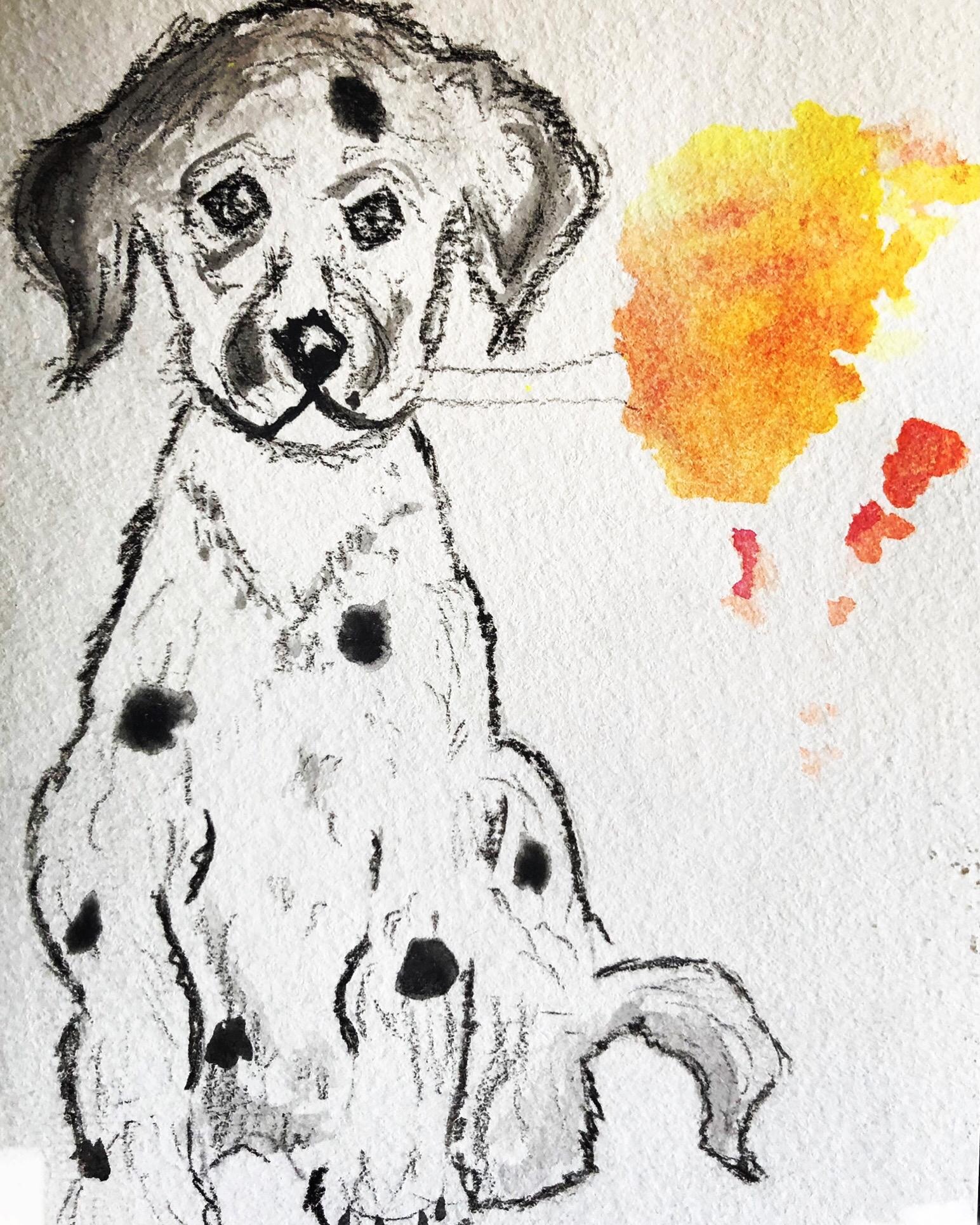
We have a new look! The lovely painting above is by our very own fr Thomas Mannion OP. What a delightful Dominican dog he is!
As you all know, on 3rd October we are holding the Elective Chapter for a new Provincial Council. It has been an enormous privilege and pleasure to serve you as editor of Veritas. My thanks to all who have contributed over the past four years. You have made Veritas yours and long may it continue!
Teresa Jankowska
Written in St Lawrence’s Church.
Built in the twelfth century. Dedicated to St Lawrence patron saint of the poor – place of welcome for poor and sick pilgrims to the Abbey and shelter for wounded and dying soldiers in the Battle of Evesham.
Sunlight streaming through coloured glass
Stirring ancient memories
Dark shapes in candlelight
Muffled footsteps on stone
Quiet murmurs of prayer
Voices raised in harmonious chant
Echoes of strife
Battles and war
Echoes of suffering
Poverty and pain
Cries for help
Voices of compassion
Echoes of holiness
Where love meets man
A place where angels dance
Where humanity encounters the divine.
Bethany Mulvey
My Journey to Lay Mission: An Unexpected Call
Last year, a friend invited me to enlist in the 2025 UK Lay Mission Project, a pilot initiative bringing the Institute’s formation program to the United Kingdom. I hesitated. I was in Cambridge to complete my postdoctoral research and intended to return to Italy afterward to continue establishing my consultancy work. A three-year formation program simply had no place in my plans.But my friend persisted. The Cambridge cohort needed enough applicants to open, and she assured me that I could leave anytime. As a favor to her, I said “yes”.
I did not realize that this reluctant “yes” would begin changing the direction of my life.
At our first retreat in Leicester on the Beatitudes, I encountered a truth that deeply challenged me: as a lay person, I am also called and sent on mission. Mission is not reserved for priests, religious, or missionaries in distant places. Through Baptism, I am called to make Christ present in the ordinary circumstances of life. Before leaving the retreat, I asked our program director, Fr. Mike, “How will I know my mission?” With his gentle smile, he replied, “Complete the course.”
Our first course, Lay Vocation, helped me understand his answer. Being a lay is also a vocation. Our families, professions, relationships, and communities are precisely where we are called to witness to Christ. I began asking myself not simply, Where is God sending me? but, To whom has God already sent me? Our second course, Scripture, transformed my relationship with God’s Word. Through the course, particularly Fr. Francis Moloney’s Reading the New Testament in the Church, I discovered the richness and historical depth of Scripture. More importantly, I developed a desire to know Our Lord more intimately through His Word.
And the answer to my question about the mission has slowly begun to emerge.I have reconnected with my family. We now pray together daily through Lectio Divina and a decade of the Scriptural Rosary. I have come to recognize that my first mission is my family—to be Christ’s witness among the very people He has entrusted to me.I have also become an enquirer with the Lay Dominican Fraternity in Cambridge, where I am discovering another dimension of my calling: I am not called to journey alone. Mission is personal, but it is also communal. We need others with whom we can pray, discern, grow, and be sent.
A year later, having completed courses in Lay Vocation, Scripture, Charism Discernment, and Ecclesiology and History, I still do not know the fullness of my mission, but I am beginning to understand Fr. Mike’s answer.
What began as a favor to a friend has become a journey of conversion and discernment. Perhaps her persistent invitation was itself God’s invitation. I am learning that God does not always reveal our mission all at once. He forms us into it—through His Word, our families, our communities, and even through an unexpected “yes.”
Jellie Molino
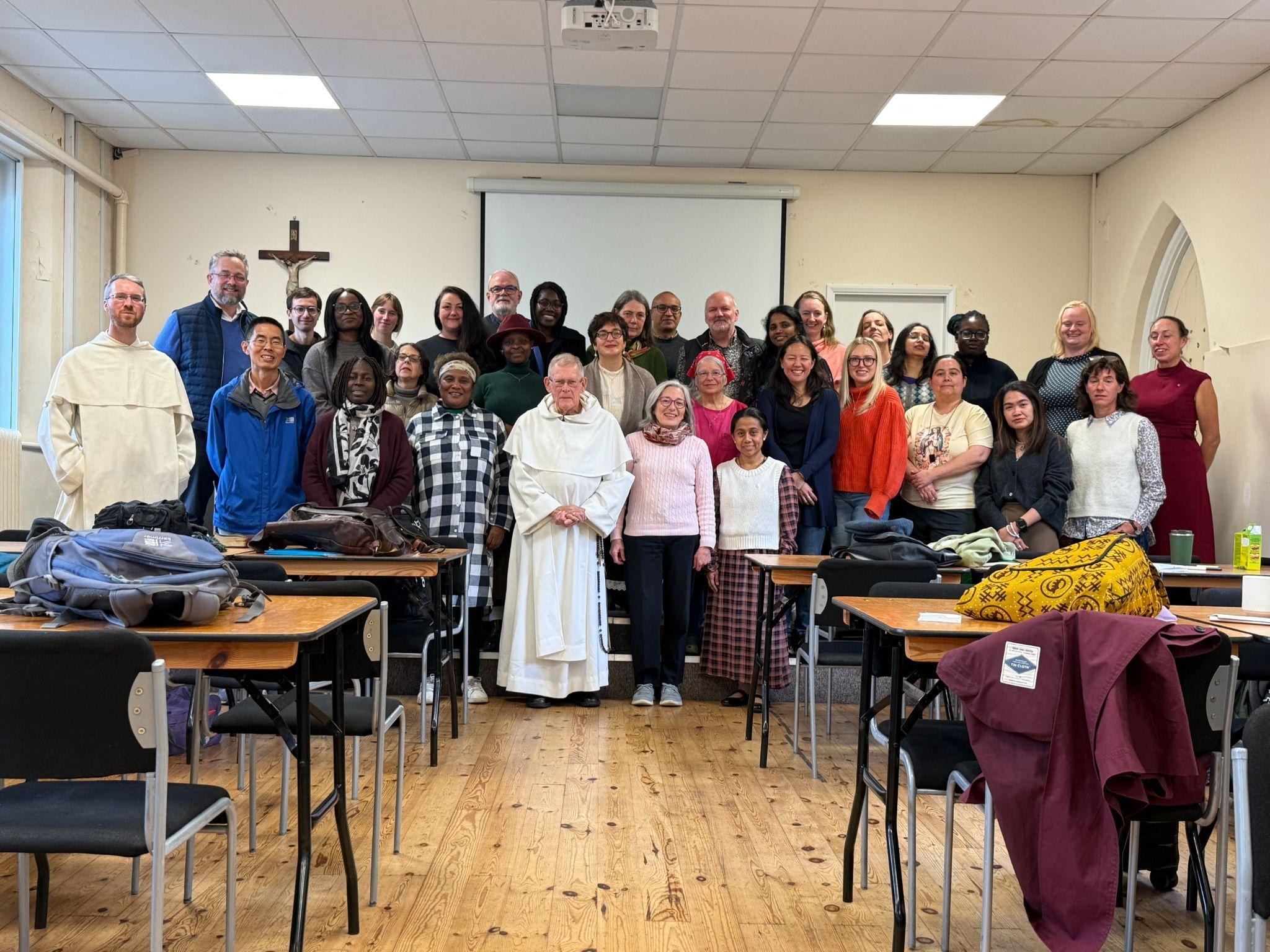
First retreat, October 2025, on the Beatitudes, held at the Frassati Centre, Holy Cross Priory, Leicester
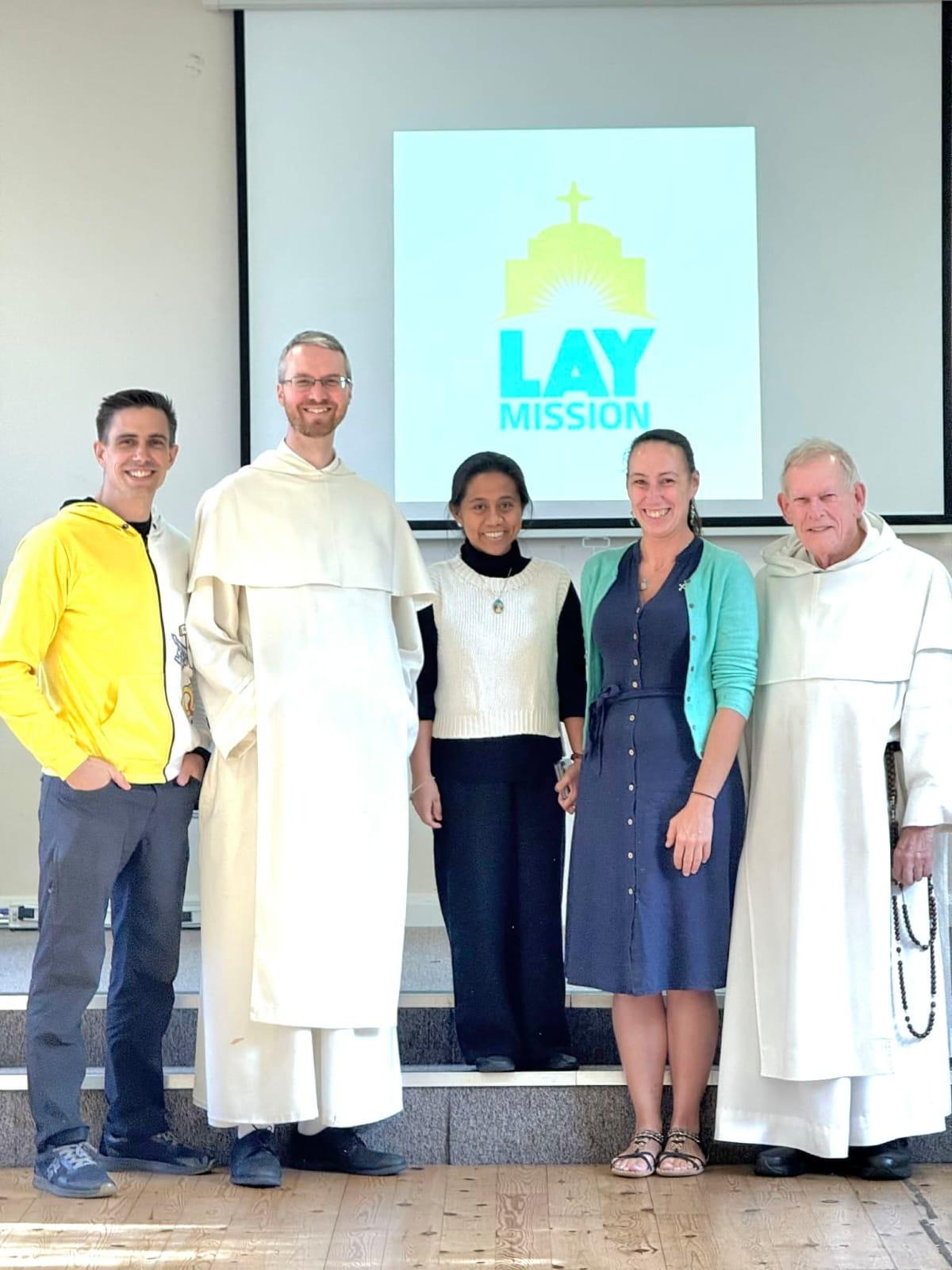
From left to right: Sean Bryan, Operations Director, fr Mathew OP, Programme Director, Jellie Molino, Catherine Wallis-Hughes, UK Lay Mission Team and fr Michael Sweeney OP, Executive Director
Searching for St Catherine in Avignon
Late July, while flames spared Bordeaux, I searched for the Dominican firebrand who reached Avignon in 1376. Since I heard St John Paul II quote, “If you were who you were called to be, you would set the world on fire”, St Catherine had long held a fascination for me. I’d embarked on an organised trip to Provence; the UK reached record temperatures and yet I ventured into hotter climbs. I also wanted to test my cycling capabilities and kayak under the Roman Aqueducts.
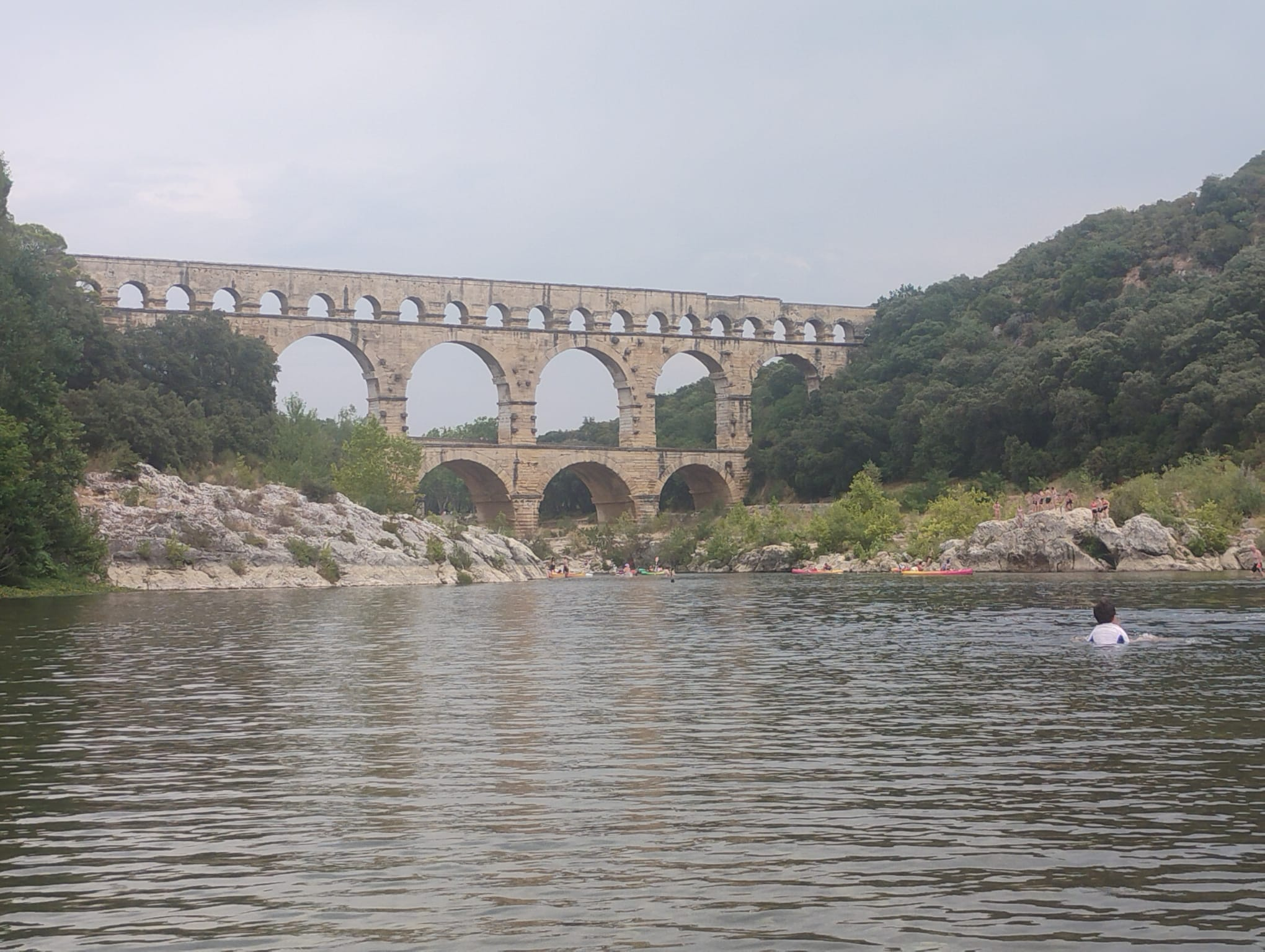
I was very interested in Avignon Popes, (the first of which, Pope Clement, appears in Dante’s inferno), as a rebuff to the resurfacing of Ultramontanism, the error that a Pope can never say or do anything wrong. I’d joked that I wanted to see “where the bad Popes used to hang out”, which was slightly unfair; One of the seven was Blessed Urban and Pope Gregory, who returned to Rome, showed some humility by listening to St Catherine.
I skipped the hottest day of cycling in 37 degrees to go to Mass and then the Papal Palace. With intrigue I stepped in and purchased the audio guide which immediately managed expectations, warning that the Palace is nothing like its heyday. The first hall’s high and magnificent walls were stripped bare, not due to “reformers” nor a resulting ideology that prevents walls from being decorated in the first place, but by the passage of time, save a patch here or there and then later a particular room that had been preserved gave a faint glimmer of what the place once was, but in the main it’s grand rooms and bare walls. It’s not used for religious worship,it has been used for exhibitions, storing weapons and as a prison, in recent times. At the campsite, some had admired the cicada’s exoskeletons. To me the Papal Palace was like a Vatican exoskeleton, cast off hundreds of years ago.
I was awed as I reached the loggia and looked through the window, realising I saw the Avignon version of St Peter’s Balcony and Square, the very same window the Popes had used to greet pilgrims. It was eerie, like a parallel universe. We take for granted seeing the Pope emerge from his balcony at St Peter’s, whereas in the 1300 this was limited to a few hundred pilgrims in the square beneath the loggia at Avignon.
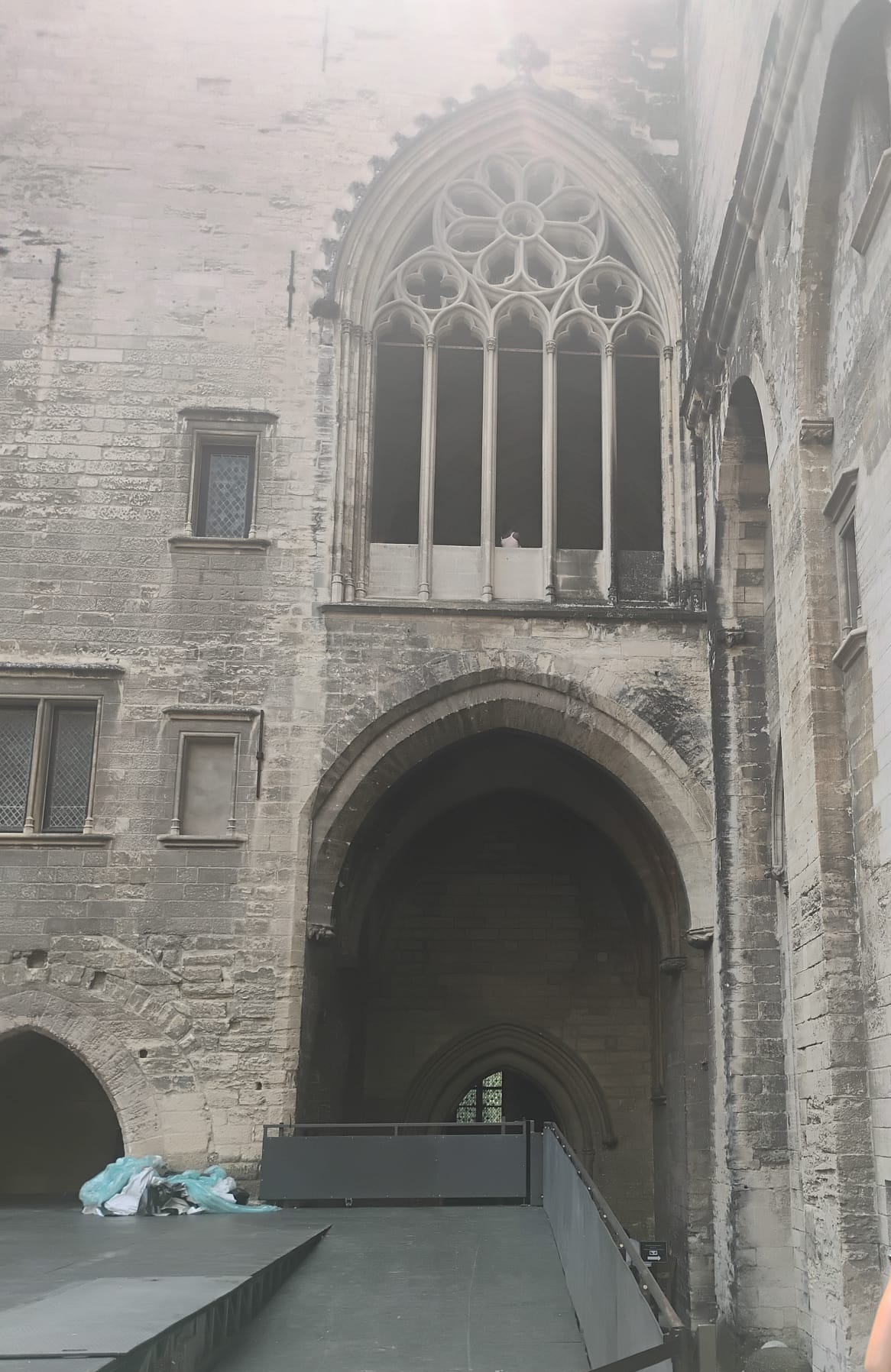
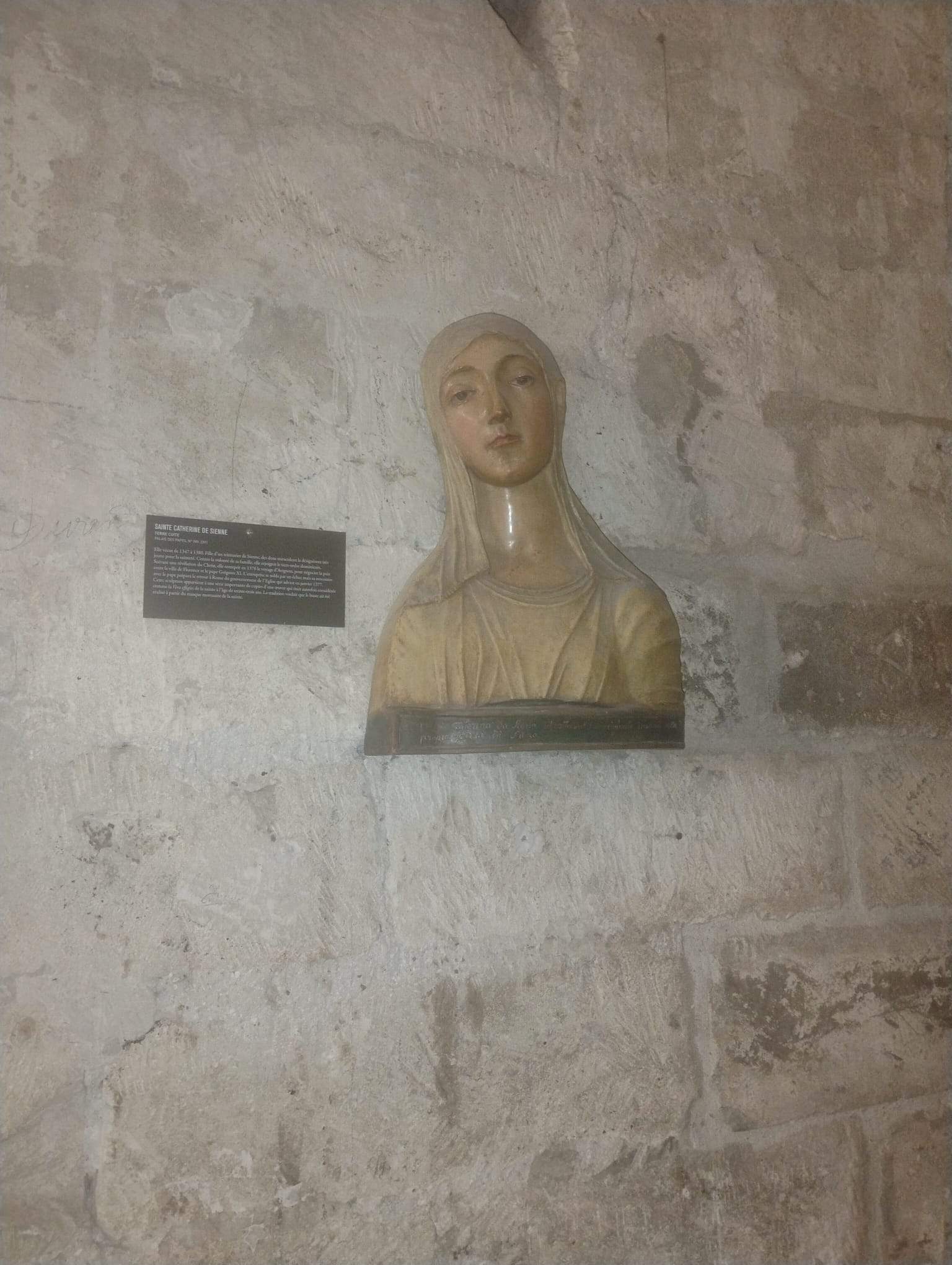
At home, I’d met a mute response about the Dominican Presence in Avignon, with good reason, as it turned out. St Catherine wasn’t mentioned in the audio guide, which declared with scandalous brevity the “Pope `decided` to return to Rome”.
I could have so easily walked past, but in God’s gracious, merciful Providence I suddenly spotted a meek 3D portrait of St Catherine of Siena, maybe taken from a cast, hardly bigger than A4 with an even smaller piece of signage, just in untranslated French. I think Avignon will need a bit of Dominican encouragement to celebrate St Catherine!
Teresa Loftus
Fra Angelico’s Crucifiction: The Only Figure Looking Back At You
Alix Murray hosts a podcast entitled Secrets of Sacred Art. Here she is sharing an episode featuring the work of Fra Angelica recently purchased by the Ashmolean. If you want to know who the figure looking back at you is, then watch her podcast/video by clicking on the link below.
Roses sent from heaven
Margaret wrote this and found it helpful to share with bereaved parents when she worked as a chaplain at East Surrey Hospital. Margaret is now retired. She has shared this with many personal friends. She hopes that others may find this useful to offer comfort to other bereaved parents.
Roses sent from heaven
Dear Mummy and Daddy
There are a few things I need to say before we say ‘goodbye’.
Thank you for the gift of my life
Perhaps you hoped that the fruit of your union would result in a baby, in me.
Perhaps it was not the right time or place for you. You may not have thought about or wanted a baby at the time.
But whatever the circumstances of my conception, I know that I was conceived in a vast explosion of God’s love and I know that I will dwell, forever in God’s love. Your coming together was the invitation God had waited for, to breathe into my empty shell, the breath of life.
My death has deprived me of the joys of life on earth, of living and loving, laughing and crying, giving and receiving, and of enjoying family life. But I know now, that these joys are only temporary. Eternity is forever and I am waiting for you here. One day, you too, will follow. I will be waiting to meet and greet you with arms open wide and love in my heart. Imagine the joy of that meeting! I want you to know that there is something wonderful waiting: ‘Somewhere over the rainbow’. There is a special place here, where we can, even now, be together in moments of peace, beautiful moments when our spirits unite in flashes of glory which radiate the glory of God to each other and to the world.
When you see the beauty of a landscape or hear the sound of the waves gently lapping the shore like a heartbeat from the heart of God, I am in that moment. When you hear a beautiful melody that makes your heart want to sing for joy, I am in that moment for I am a love song beautifully sung in the heart of God. When you hear the whisper of a gentle breeze and feel the breath of the wind on your skin, know that I am kissing you with my love, blown from my secret place, in the heart of God. I am in the look of love that radiates from innocent eyes. I am in the touch that gives and doesn’t count the cost. I am in the faithful footsteps that ever walk towards the light. I am in the breath of compassion that reaches out in love to soothe and heal your pain.
I want you to know that the gift of life was the most beautiful gift you could ever have given me and one which can never be taken away. For spiritual life is eternal. If I could tell you from where I am now, the joy and peace of this place, you would not believe me, for it is indescribable. I can drink freely of the waters of love when I am thirsty and eat from the tree of life when I am hungry. I am clothed in the white garment of innocence and I have free access to the throne of God.
My life was short but in the time we had together I knew such love. For your coming together invited the creator, my God, into a moment of time, and uncreated love gave me the gift of life.
All through my womb time, God has been my constant companion and lover, sharing with me, in that secret sanctuary, the secrets of his heart.
He created me with a purpose, to be your child and all that means. Now, forever I will be your child, interceding for you at the throne of grace in perpetual childhood. Thanks to our heavenly Father God, it is my privilege to pray for you always.
I will simply love you every day for eternity from here. I am seated at the foot of the throne of God’s grace. Every time I think of you and ask Him, He blesses you and showers you with love. These then, are my gift to you: ‘Until you touch my heart again’, showers of blessings like roses, heaven sent: ‘With love from me to you’.
Margaret McGettrick
Dominican Saints
5 October is the feast of Blessed Raymond of Capua (1330-1399). After studies at the University of Bologna he was miraculously called by St Dominic to join the Dominicans, where he combined learning with modesty.
His indifferent health held him back from the rigours of strict observance. In 1374 he was appointed as Lector to the Dominican Convent in Siena where he met St Catherine, whom he learned to call his Mother, and became one of her informal group of Caterini and St Catherine’s promised, by Our Lady, confessor, and confidant.
He was initially concerned about the source of the saint’s visions, ecstasies and extraordinary mortifications, but his doubts were eventually assuaged and he was present in Pisa when St Catherine received the stigmata. He accompanied her on her journeys. He played an important rôle in procuring the return of the Pope from Avignon and in trying to mitigate, latterly as the legitimate Master General, the 40 year Schism that began in 1378 and which affected the Order as well as the Church, and the ravages of the Black Death.
He was in Genoa, on the orders of Pope Urban VI, when he learned miraculously that St Catherine had died that day, 29 April 1380. He governed the Order for 19 years and earned the title of “Second Founder” for his work of reform. He was used by various Popes in difficult negotiations and wrote the Life of St Catherine. Exhausted, he died in Nuremberg on 5 October, 1399, whence his remains were removed to Naples. He was beatified 50 years after his death.
On 3 November we celebrate the feast of St Martin de Porres (1569-1639). He was born in Peru of an indigenous mother and a Spanish knight who disliked his son’s appearance, inherited from his mother. He practised charity and self denial from a young age and studied medicine and surgery so that he could help the poor more efficaciously.
Although Our Lady told him to join the Dominicans he refused the habit of a choir religious or the rôle of a lay brother and became a Tertiary and the Infirmarian of the Convent of the Holy Rosary, in which position he ministered to the poor of Lima as well as to the Dominican community. He fed the poor, obtaining the miraculous multiplication of what he had as necessary; founded an orphanage; and cared for the many stray animals in the city – he is an intercessor against the depredations of rats and mice etc. To fortify himself for these tasks, he practised severe mortifications and fasting and he was reputed to have the ability to bi-locate. He died in Lima on 5 November 1639 and was beatified by Pope Gregory XVI.
Howard Trust
A Dominican Table
Edinburgh Fraternity is inviting Lay Dominicans in the province to offer a recipe or two for a new recipe book entitled A Dominican Table.
The recipes should be of significance to you, perhaps a family favourite, or your ‘go-to’ for welcoming friends and family, or perhaps something that you grew up treasuring.
Everything from Oatcakes to Soups, Pavlova to Stew, Pastries to Fish Pie. We welcome a range of contributions, from the most hearty warming soups, to the more involved ‘grand’ fare.
If there is a short reflection, short scripture extract or line of poetry to accompany the recipe that would also be welcome. More information can be found here:
https://dominican-table.weebly.com

This is the QR code for the site.
Lee Patterson
On being a ‘Sign of Contradiction’
At the opening of the Congress of European Lay Dominican Fraternities in Ireland this summer, Archbishop Dermot Farrell of Dublin advised us that amongst other things “you are also called to be “signs of contradiction’ in the world”.
For a Christian, to be a “sign of contradiction” is a phrase with deep biblical and traditional roots. The Latin term ‘signum cui contradicetur’ means either ‘which is contradicted’ or ‘whom is spoken against’.
It comes from the prophecy of Simeon to Mary at Jesus’s presentation in the Temple: “This child is destined to cause the falling and rising of many….and to be a sign that will be spoken against” (Luke 2:34).
To be such a sign of contradiction means to embody a truth or way of life that, by its very nature, engenders resistance because the truth it stands for cuts against the grain of the prevailing culture. It is to be a living paradox in a world that cannot easily be categorized or ignored. It requires that we do not live in comfortable and quiet conformity but are to be a visible and sometimes noisy or uncomfortable witness to alternative ways of thinking, being and doing in the world.
It is to be counter-cultural in its most meaningful sense.
For lay Dominicans this may mean a number of things.
Intellectual contradiction: Dominicans have a charism built on study, preaching, and truth-seeking. Being a “sign of contradiction” might mean holding to the idea that truth is knowable and worth pursuing rigorously, against a cultural current that treats truth as purely relative, subjective or simply open to self-definition.
Contradiction through public witness: It can mean demonstrating radical compassion and empathy in ordinary settings such as workplaces, families and civic life rather than from within religious community structures or roles. The “sign” is precisely that it shows up in secular life, not just in a church, friary or convent.
Contradiction through upholding the dignity of every human person: Christianity teaches that every person has inherent, God-given dignity from conception to natural death. In a culture that often values people for their productivity, autonomy, or utility, and that increasingly accepts practices such as assisted suicide, this teaching is a sign that will be contradicted. The Christian preference for the poor, the immigrant, the unborn, the elderly, and the disabled will also be a contradiction. One that proposes that the last shall be first.
Embracing a countercultural understanding of freedom: Contemporary culture often defines freedom as the absence of limits and the right, or even duty, to do whatever one desires. For Christians, freedom is the capacity to choose the good enabled by grace. True liberation comes through self-emptying and a freedom from attachment to power, wealth, status.
Forgiving when the culture demands vengeance: In a time of manufactured civic and political polarisation, Lay Dominicans eschew vengeance culture, outrage culture, cancel culture, political polarisation and public shaming. Our way is to forgive our enemies and to seek a culture of collective truth-seeking and peace through encounter and reconciliation. Such a radical contradiction of current norms does not deny discernment of justice, but it refuses to let hatred or violence have the final word.
Suffering with meaning: Perhaps the most profound contradiction is the Christian claim that suffering can have redemptive meaning. In a culture that seeks to eliminate all emotional or physical pain and often treats unavoidable suffering as meaningless, the Christian may, with grace, transform suffering into a hopeful spiritual journey. It is a living sign that death and pain do not have the last word.
The sign of our contradiction should always remain as an invitation to the world and not a condemnation of it. Being a sign of contradiction isn’t meant to make us combative or morally superior; it’s meant as a visible alternative that provokes questions. This may draw others into a world that is infinitely larger and more sacred than they have known.
Christ was himself a sign of contradiction, but He was also full of grace and truth. He ate with sinners, embraced lepers, and forgave His executioners. The contradiction came from the truth He embodied, not from a lack of love.
Christ’s sign was neither silent nor hidden. Catherine of Siena understood this well. She counselled: “preach the truth as if you had a million voices. It is silence that kills the world”.
Dominic Harrison
“Sing praises to God, sing praises; sing praises to our King, sing praises”(Psalm 47:6)
Margaret McGettrick has composed music and written lyrics which reflect her spiritual journey in song. Perhaps there is someone who would like to collaborate with Margaret? I can send you three of her songs via WhatsApp. If so, let me know:
Celebrating St Dominic’s Day in Durham
Members of Lay Dominicans North East celebrated St Dominic’s Day earlier this year with Mass, brunch at a Durham restaurant and a mini-pilgrimage to the shrine of St Cuthbert at Durham Cathedral before visiting one of our less-mobile members at his home, where we recited the Rosary with him.
But why was it appropriate to visit the shrine of St Cuthbert, who died in 687AD, nearly 500 years before St Dominic was born? In all probability, Dominic will never have heard of Cuthbert. In Dominic’s lifetime, and even in England, the Anglo-Saxon saint’s light had dimmed a little as a result of a new saint, Thomas Becket, who had been murdered in the year of Dominic’s birth and to whom devotion had quickly and widely grown.
However, as well as Cuthbert still holding a special place in the hearts of the people of the North East, we see in him a kindred spirit to Dominic, especially in the arena of preaching.
The Venerable Bede, in his Prose Vita of Cuthbert, whom he clearly admired, gives a wonderful account of Cuthbert the Preacher. Bede writes: “…not only did (Cuthbert) give the monastery itself counsels…but he sought moreover to convert the neighbouring people far and wide from a life of foolish habits to a love of heavenly joys. For many of them profaned the faith they held by wicked deeds, and some of them also at the time of the plague, forgetting the sacred mystery of the faith into which they had been initiated, took to the delusive cures of idolatry… So he frequently went forth from the monastery to correct the errors of both kinds of sinners, sometimes riding on a horse but more often going on foot, and came to the neighbouring villages and preached the way of truth to these wanderers…
…Now he was wont to penetrate those parts especially and to preach in those villages that were far away on steep and rugged mountains, which others dreaded to visit and whose poverty as well as ignorance prevented teachers from approaching them. And giving himself up gladly to this pious labour, he attended to their instruction with such industry that, leaving the monastery, he would often not return home for a whole week, or even two or three and even occasionally for a full month, summoning them to heavenly things by the words of his preaching and the example of his virtue.” (Prose Vita: Book 1, Chapter 9)
To use a more modern phrase, Cuthbert went out to the margins and even beyond the margins on his preaching missions. For Cuthbert, preaching was done on the road as much as in a church. This drive to bring what Bede refers to as ‘heavenly things’ to the people is also a drive that animated Dominic, who brought comfort and correction to those who had forgotten the “sacred mystery” of faith. And so, Cuthbert and Dominic are indeed kindred spirits, united in apostolic preaching. And we honour them both.
St Cuthbert and St Dominic, preachers of the Word. Pray for us.
St Cuthbert and St Dominic, lovers of the Truth. Pray for us.
St Cuthbert and St Dominic, restless for the salvation of souls. Pray for us.
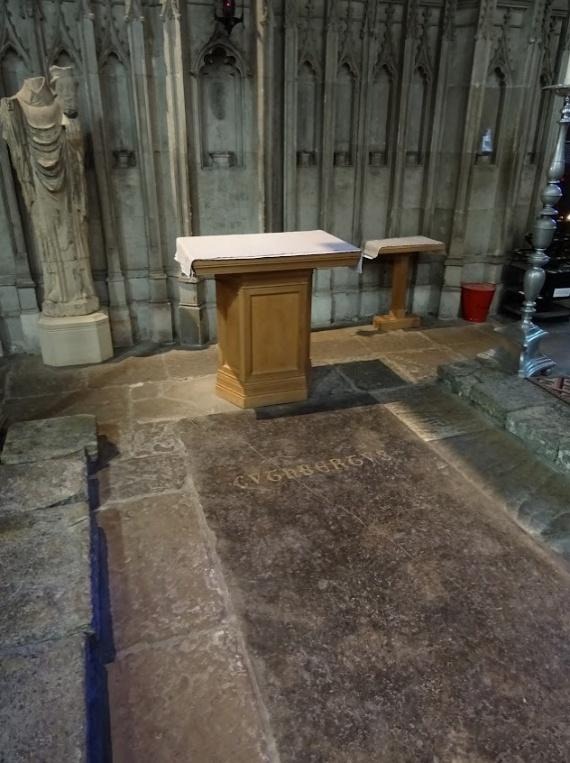
Burial place of St Cuthbert – a simple slab with the name “Cuthbertus”
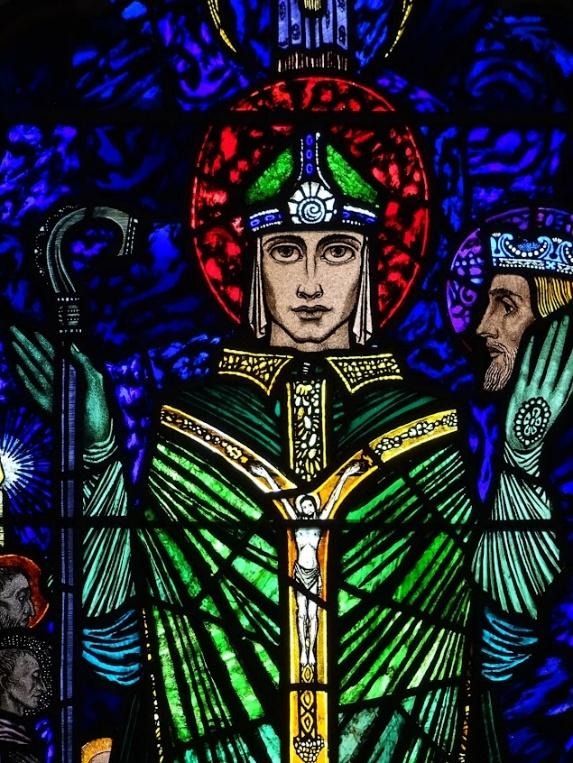
Stained glass image of St Cuthbert, crafted by Harry Clarke in 1931 for St Cuthbert’s Catholic Church in Durham, where Lay Dominicans North East are based.
Andy Doyle
Requiescant in Pace
We remember with affection and gratitude all the recently departed,
- Ian Gardner (Oxford)
- Johnny Morris (London)
May they and all the faithful departed, through the mercy of God, rest in peace.